
AI Buying-Committee Mapping in 2026 — Evidence-Bound Roles Before Outreach
Map B2B buying committees with evidence-bound AI: six roles with evidence rules, coverage minimums that gate outreach, staleness TTLs, and human ratification.
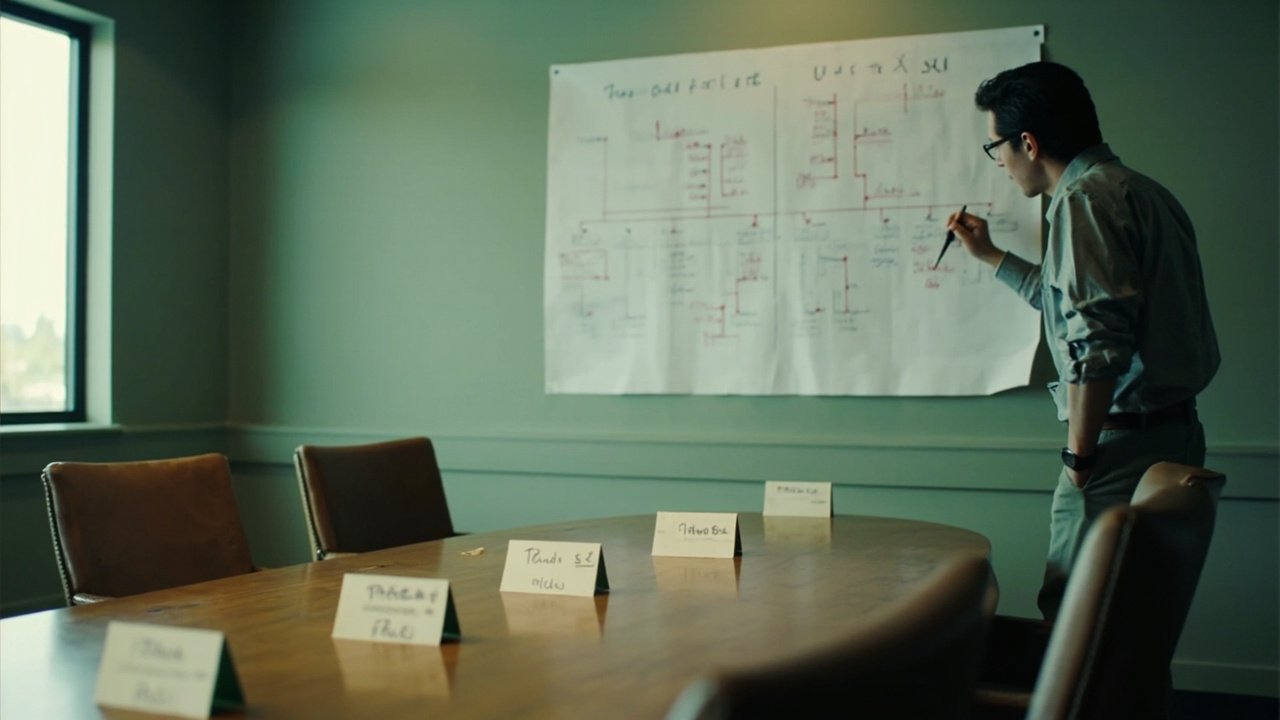
Every B2B seller has watched a deal die in a room they never saw. The demo went well, the champion was enthusiastic, and then the purchase quietly failed somewhere between a finance vice president who never replied and a security reviewer nobody had met. The failure was not messaging. It was coverage. The buying committee — the group of stakeholders whose consent a purchase actually requires — was never mapped, or was mapped once and never re-verified, and the sequence spent its touches on the one person who happened to answer the phone. Harvard Business Review's research on the modern B2B purchase describes exactly this environment: customers who are deeply uncertain and stressed, facing "virtually infinite information available on any solution, a swelling raft of stakeholders involved in each purchase, and an ever-expanding" set of options (HBR, The New Sales Imperative; ev-bcm-001). This article is about how to map that committee with AI in 2026 — and about the discipline that keeps the map trustworthy: evidence-bound roles, coverage minimums that gate outreach, staleness expiry, and human ratification.
The direct answer
Map the buying committee as a set of role assignments, and make every assignment carry its evidence. For each person, record the role you believe they hold — champion, economic buyer, technical evaluator, end user, procurement, or blocker — together with the observed signal that licenses that belief, the source it came from, the date it was observed, and a confidence the model can defend. Gate outreach on coverage: define the minimum set of identified roles an account must show before any sequence may start, and route accounts below the minimum back to research rather than into cadences. Expire role assignments on a time-to-live basis so that committee churn forces re-verification instead of silent staleness. And keep the division of labor explicit: the AI proposes role assignments and coverage calculations from evidence; humans ratify the assignments that matter, correct the ones that are wrong, and own the map's consequences. Salesforce's State of Sales research reports that nine in 10 sales teams use AI agents or expect to within two years (Salesforce; ev-bcm-002), which means machine-proposed committee maps are already an operating reality for most programs. The choice teams actually face is not whether AI will help map committees; it is whether the map will be evidence-bound or vibes-bound.
Why committees defeat rep memory
The traditional answer to committee mapping is tribal knowledge. A senior rep knows the account, knows that "Dana actually signs everything over 50k," and knows to avoid the infrastructure team until late. That knowledge is real, expensive, and fragile. It walks out of the building on resignation day, it never existed for the two hundred accounts the team has not worked yet, and it is expressed in prose that no downstream system can check. The HBR research on buying complexity points to why the load keeps growing rather than shrinking: the stakeholder group involved in each purchase swells as solutions and information multiply (ev-bcm-001), so the map a rep holds in memory degrades faster each quarter than the quarter before.
Tribal knowledge also fails a specificity test when it is written down at all. CRM contact records carry titles, and teams infer roles from titles as a matter of habit: a "VP" must be the economic buyer, "IT" must be the technical evaluator. Titles are a prior, not evidence. Reorganizations silently hollow out titles. The economic buyer on a 40,000-dollar deal is a director; on the next deal at the same company it is a vice president, because the threshold moved. The person with the impressive title is the sponsor's chief of staff with no budget authority at all. A committee map built on title inference is a probability distribution wearing a org-chart costume, and every downstream decision — sequencing, messaging, meeting strategy — inherits its errors. The fix is not better titles. The fix is binding each role assignment to observable evidence.
The six-role taxonomy and what each role is for
A workable committee map needs a small, mutually exclusive role set. Six roles cover the overwhelming majority of B2B purchases. The champion actively advances the purchase inside the organization: they share internal documents, volunteer context, and spend their own political capital. The economic buyer can release the funds and absorbs the budgetary consequence of the decision; the identifying question is not "who is senior" but "whose budget does this come from and who signs." The technical evaluator judges fit against architecture, security, and integration constraints, and can kill the deal without ever opposing it. The end user lives with the product daily; their adoption determines realized value, and in mature buying organizations they hold real veto power. Procurement owns the commercial process — vendor registration, competitive bids, contract terms — and treats an unmapped procurement function as a late-stage ambush. The blocker, finally, is any stakeholder whose opposition can stop the purchase: a rival vendor's sponsor, a team that loses headcount to automation, a security office with a quiet policy against new tools.
Each role earns its place on the map by what it changes about outreach. Champions get enablement and early access, not pitches. Economic buyers get business-case language tied to the outcomes they are measured on. Technical evaluators get documentation and a sandbox, and get them early, because their evaluation clock is the longest. End users get the product's daily reality. Procurement gets process compliance before they ask for it. Blockers get a deliberate strategy — engagement, neutralization, or routing around — chosen consciously rather than by omission. A map that cannot say which contacts hold which roles cannot make any of these distinctions, and the sequence degenerates into the same message sent to everyone with a pulse and an email address.
What counts as evidence for a role assignment
The evidence standard is the heart of the design. For a champion assignment, the evidence is behavioral: shared internal threads, meeting invitations that include other stakeholders, unprompted context about decision process or timeline. For an economic buyer, the evidence is structural and documented: an approved budget line the contact owns, a signature on a previous same-magnitude contract, a statement in a call transcript — recorded, not remembered. For a technical evaluator, it is functional ownership: the security questionnaire routed to them, the architecture review they ran for the last vendor. Procurement is identifiable from process artifacts: vendor onboarding emails, bid documents, the contracting portal. Blockers are the hardest and the most valuable; their evidence is usually second-order — a rival implementation they championed, a public statement of tooling standards, an escalation they filed against a previous purchase — and the confidence on blocker assignments should default lower accordingly.
Three evidence grades keep the model honest. Direct evidence — the person said or did the role-thing in a recorded channel — supports high confidence. Corroborating evidence — a second source agrees with a first — raises confidence but cannot substitute for direct evidence on the roles that gate expensive actions. Inference — title, seniority, department — never supports a ratified assignment; it supports a candidate. The AI's job is to turn inference into candidates and evidence into proposals; the human's job is to ratify. This division is exactly the trustworthiness posture the NIST AI Risk Management Framework asks operators to adopt: a voluntary, consensus-driven baseline for incorporating trustworthiness considerations into the design, development, use, and evaluation of AI systems (NIST AI RMF; ev-bcm-003). A committee map is an AI system's output that humans act on at cost, and it should be built to that standard.
Coverage ratios that gate outreach
Once roles are assigned, coverage becomes measurable. Define required-roles per deal motion: a mid-market SaaS motion might require, minimally, an identified champion plus an economic buyer candidate plus one of {technical evaluator, end user} before first touch. The coverage ratio is identified-and-current roles divided by required roles. Below the minimum, the account is a research object: the correct next action is evidence collection, not a sequence enrollment. This is the single highest-leverage rule in the design, because the common failure mode of modern outbound is spending scarce touch budget — contact budget, in the framing of our earlier article on agentic prospecting contact budgets — on an account whose committee is one person deep. Sequencing a single contact is not account-based anything; it is cold outreach wearing an ABM badge.
Coverage also disciplines territory economics. A team that reports "we worked 400 accounts this quarter" has said nothing; a team that reports "140 accounts met committee minimums, 90 went to sequence, and coverage-lift work moved 60 accounts over the minimum" has described a machine. The metric that matters is coverage lift: accounts moved from below-minimum to above-minimum by deliberate research effort, per week, per researcher. That number is manageable, forecastable, and honest in a way that activity counts are not.
Staleness, TTLs, and re-verification
Committees are not static. The champion takes a role at another company; the economic buyer's budget is frozen and re-issued to a different cost center; procurement centralizes and the old contact leaves the process. Every role assignment therefore carries a time-to-live, and the TTL differs by role because churn risk differs by role. Editorially, champion and economic-buyer assignments deserve the shortest TTLs — they gate the most expensive actions and they churn fastest — with technical evaluator and procurement close behind, and end-user assignments somewhat longer. When a TTL expires, the assignment does not delete; it downgrades to unverified, which removes it from coverage calculations until re-verification produces fresh evidence or a human re-ratifies. The map thus degrades gracefully: stale facts stop counting before they start misleading.
Re-verification should be event-driven where possible. A funding announcement, an earnings call naming a new operations lead, a job-change alert on a mapped champion — each is a trigger that a specific assignment must be re-checked before it is next used. This is where AI earns its keep honestly: not by generating confident guesses about roles, but by watching for the events that make yesterday's ratified map wrong and flagging exactly the assignments those events touch.
Propose, ratify, correct: the division of labor
The workflow that holds all of this together is propose-and-ratify, and it is the same pattern that governs well-run ICP maintenance at the firm level (agentic ICP drift ratification) applied at the person level. The AI proposes: role assignments with evidence attached, coverage calculations, staleness flags, and change events. Humans ratify: the assignments above a risk threshold — anything gating an expensive action, any blocker assignment, any role change on an active deal — get a human review with the evidence displayed, and ratification is a recorded act with a name and a timestamp. Corrections flow back as training signal in the most literal sense: every corrected assignment is a labeled example that makes the next proposal better, and the correction log is the dataset that a model-improvement cycle actually wants.
The audit trail is the artifact that makes the whole system defensible. For any touch that went out, the map should be able to answer: which roles were identified, on what evidence, ratified by whom, how current was each assignment on the day of the send. Programs that can answer that question can improve, because errors are findable. Programs that cannot are condemned to re-learning the same ambushes — the security reviewer, the frozen budget, the champion who left in March — at full price every time.
A five-week rollout
Week one: fix the taxonomy. Adopt the six roles, write the evidence rules and TTLs per role, and set coverage minimums per deal motion with the sellers who will live inside them. Week two: backfill the accounts that matter most by hand — the open pipeline — and measure how long honest mapping actually takes; that number sizes the research capacity you need and is always larger than expected. Week three: turn the AI on in proposal-only mode. It proposes assignments and coverage from the evidence corpus; humans accept, correct, or reject, and the correction log starts filling. Week four: enforce the coverage gate in the sequencing tool — below-minimum accounts route to research queues, not cadences — and watch the bounce between sales and research that the gate produces; that friction is the system working, and it needs an owner with authority to arbitrate. Week five: review the numbers — proposal acceptance rate by role, coverage lift per week, staleness catches — and only then expand autonomy for the AI's low-risk proposals. The failure mode to avoid is reversing the order: granting the model ratification authority in week one and hoping evidence discipline will arrive later. It will not.
Frequently asked questions
Why not just let the AI map committees from titles and get on with it?
Because titles are priors, not evidence, and every expensive downstream decision — sequencing, messaging, meeting strategy — inherits the error. The design here does not ask the AI to be less useful; it asks the model to do the part it is genuinely good at (watching events, correlating signals, drafting assignments) while the evidence standard and human ratification keep the map's costly parts honest. Nine in 10 sales teams are already operating with agents in the loop (ev-bcm-002); the differentiator is whether their outputs are checkable.
How is this different from an account contact budget?
The contact budget decides how many people you may touch at an account and how touches are spent — frequency economics. Committee mapping decides which people matter and whether you know enough to start: identification and coverage. The two compose: a mapped committee with roles and coverage feeds the budget, which then governs cadence. Our agentic prospecting contact budget article covers the second half of that pipeline.
How often should a committee map be re-verified?
Per-role TTLs rather than one blanket cadence, because churn risk is role-specific: champion and economic-buyer assignments expire fastest, and event triggers (job changes, funding, reorgs) force re-checks ahead of schedule. An assignment that expires downgrades to unverified and stops counting toward coverage until fresh evidence or human re-ratification restores it. The map should go stale loudly, not silently.
SOURCES & EDITORIAL NOTE
Harvard Business Review's The New Sales Imperative (ev-bcm-001), Salesforce's State of Sales (ev-bcm-002), and the NIST AI Risk Management Framework (ev-bcm-003) ground the buying-complexity, adoption, and trustworthiness claims in this article. The six-role taxonomy, evidence grades, TTL values, coverage minimums, and the five-week rollout are SellersGPT editorial recommendations to be calibrated against each team's own account history.
MORE PRACTICAL IDEAS FOR B2B GROWTH
Related Articles



BUILD A PIPELINE THAT YOUR TEAM CAN SEE
Find more B2B buyers-without building a bigger team first. Tell us what you sell, which markets you want to reach, and what should count as a Qualified Lead. We'll help you build a repeatable path to the right buyers.