
AI Business Directory Data-Quality Governance in 2026 — Let the Agent Resolve Entities, but a Human Audits the Edge Cases
AI business directory governance sets the 0.82 entity-resolution threshold, tiers freshness audits at 30 or 90 days, and routes edge cases to a named human ratifier.
1. AI business directory data-quality governance in 2026 is the
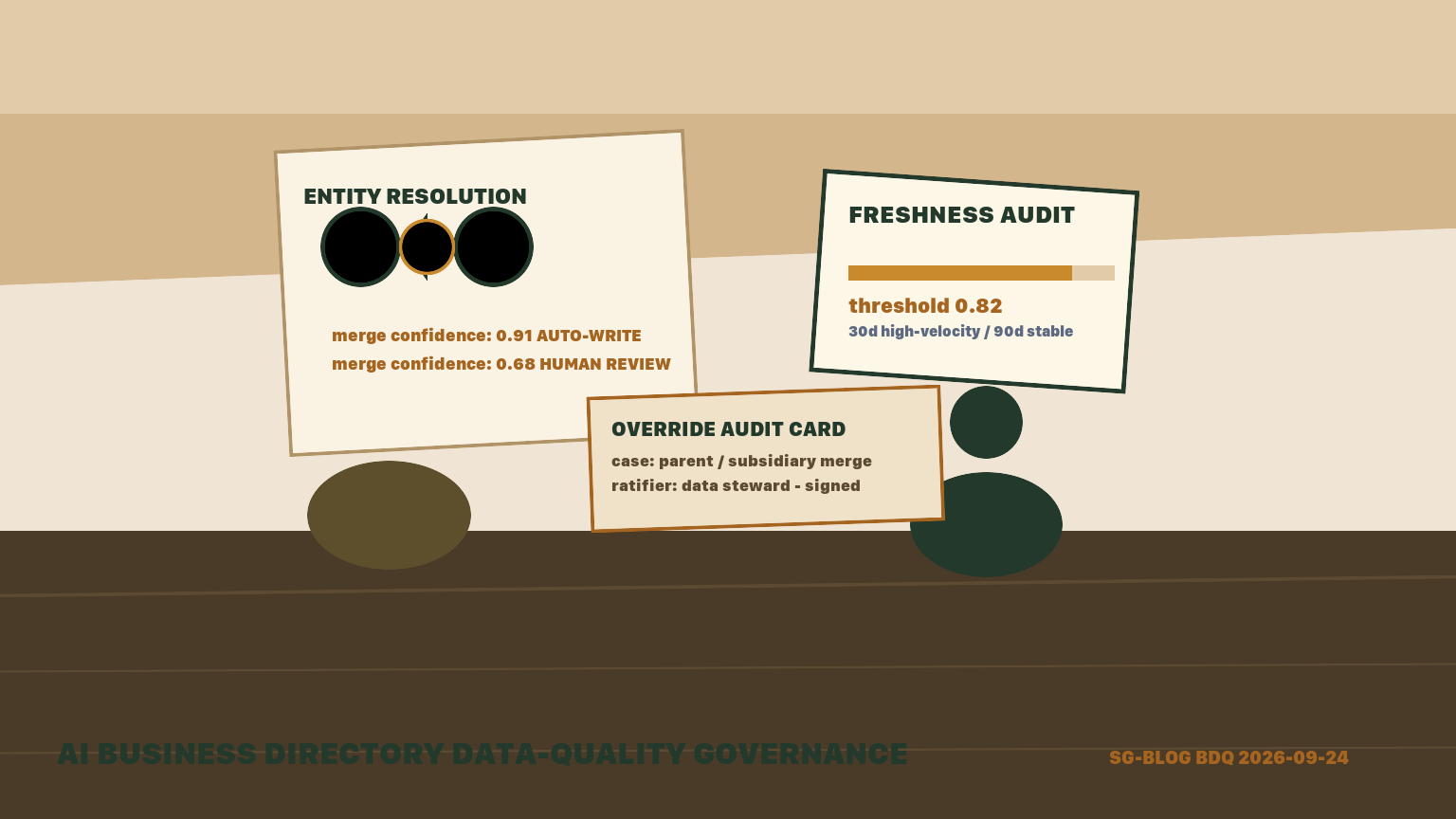
AI business directory data-quality governance in 2026 is the written program that decides what entity-resolution confidence threshold an AI-powered business directory must clear before it writes account records to the CRM automatically, what freshness audit cadence keeps each segment of the directory honest, and which edge cases — parent-subsidiary structures, rebrandings, acquisitions — route to a named human ratifier with documented override authority instead of the automated pipeline. The operating philosophy is captured in the title: let the agent resolve entities, because machines are better than people at matching ten thousand records against a reference graph; and let a human audit the edge cases, because people are better than machines at knowing that the conglomerate that just acquired your customer is not, in fact, a new customer. Governance is the boundary between those two assignments of work, written down, measured, and signed.
The reason the boundary needs writing down is that the automated path fails at the edges, and the failure is expensive. Salesforce's State of Sales, 8th Edition (2025) finds that 63 percent of B2B sales organizations using AI-powered business directories reported at least one entity-resolution error that led to a misrouted opportunity in the last 12 months. A misrouted opportunity is not a data blemish; it is a buying signal delivered to the wrong account team, under the wrong relationship history, at the moment the buyer was ready to talk. The same research finds that only 19 percent of those organizations had a named data steward ratifier with documented override authority over entity-resolution decisions. Read together, the two numbers describe an industry that automated the matching and skipped the accountability: most organizations have the errors, few have the person whose job it is to catch them.
2. The entity-resolution confidence threshold is the first control of
The entity-resolution confidence threshold is the first control of the program. Dun & Bradstreet's Data Quality Best Practices (2024 Update) recommends a documented threshold of at least 0.82 — meaning that when the directory's matching model proposes to merge or create an account record, it must be at least 82 percent confident that the source record and the resolved entity are the same company before the write happens automatically. Above the threshold, the agent resolves and writes. Below it, the proposed resolution becomes a review item for the named ratifier. The number itself matters less than the fact that it is written, owned, and enforced; D&B's research context makes the cost of its absence concrete: organizations without documented thresholds reported a 31 percent increase in duplicate-account creation after directory refresh events. Duplicates are the slow failure — each one silently splits an account's activity history, and the pipeline report discovers the split quarters later.
The freshness audit cadence is the second control, and it is tiered because not all corporate data decays at the same speed. D&B's best practices set the cadence at 30 days for high-velocity segments — parent-subsidiary structures and mergers-and-acquisitions activity, where ownership and hierarchy change on deal timelines — and 90 days for stable segments. The governance program writes both numbers down, assigns each directory segment to a tier, and runs the audit on schedule: a sample of records per segment is verified against the reference graph, and the segment's error rate is filed with the ratifier. The tiering is the control's real content. A single flat cadence either burns auditing effort on stable records or, worse, treats M&A-active records as stable and lets a quarter of corporate restructuring land unverified in the CRM — which is exactly the window in which entity-resolution errors misroute opportunities.
3. The edge-case routing list is the third control, and
The edge-case routing list is the third control, and it is the human half of the title's bargain. Three families of edge cases belong on the list by default. Parent-subsidiary structures, because a buying signal from a subsidiary can be a divisional purchase or a group-level mandate, and the difference determines which account team owns it. Rebrandings, because the renamed company keeps its relationship history, and a model that treats the new name as a new entity amputates that history at the exact moment it matters most. Acquisitions, because the acquired company's records must fold into the acquirer's hierarchy without collapsing the operating entities that still buy independently. Each of these cases is routine for a human analyst with the relationship context and pathological for a matcher that only sees name and domain similarity. The routing list tells the pipeline which patterns skip the automated write entirely and land in the ratifier's queue with the evidence attached.
The named data-steward ratifier is the fourth control, and the research is unusually direct about how rare and how load-bearing this role is. The OECD AI Principles (updated 2024) require that organizations using AI for entity-resolution and directory-management tasks maintain transparent, auditable records of the model's resolution logic, and that a named human reviewer ratifies decisions below the documented confidence threshold. NIST's AI Risk Management Framework 1.0, in its GOVERN function, requires organizations to document the roles, responsibilities, and lines of communication related to AI-driven directory-data decisions, including a named data steward ratifier with a documented audit cadence for entity-resolution overrides. Two independent frameworks, one instruction: below the threshold, a person decides, the person has a name, and the decision leaves a record. The 19-percent figure from Salesforce's research says most organizations do not have this person yet; the governance program is how they get one.
4. The override audit trail is the fifth control, and
The override audit trail is the fifth control, and it is the artifact that makes the ratifier's work inspectable. Every override — the ratifier's decision to accept, reject, or correct a proposed resolution below the threshold — is logged with the proposed resolution, the model's confidence score, the evidence the ratifier consulted, and the rationale. The OECD's transparency requirement points at exactly this artifact: the resolution logic is auditable, which means both the model's automated decisions and the human's overrides have to be reconstructable after the fact. The trail is also the program's learning loop. A quarterly review of override patterns tells the program which edge cases recur, whether the 0.82 threshold is set at the right level for the directory's data quality, and which segments deserve a tighter freshness cadence. The overrides are not noise in the governance program; they are its highest-resolution signal about where the automated path actually breaks.
Schema drift detection is the sixth control, and it guards the directory's own structure. The directory's schema — its fields, hierarchies, and relationship types — is the frame the entity-resolution model resolves within, and when the schema drifts (a new hierarchy level for holding companies, a repurposed industry field, a renamed relationship type), resolutions that were correct under the old frame become incorrect under the new one without any single record changing. The weekly drift pass compares the live directory schema against the registered version, the same discipline the field-schema governance programs run on the CRM side, and routes divergences to the ratifier before the resolution model inherits them silently.
5. Assembled, the six controls form a weekly and quarterly
Assembled, the six controls form a weekly and quarterly cadence. Weekly: run the schema drift detection, review the sub-threshold resolution queue, and file the ratifier's overrides with evidence and rationale. Monthly, on the 30-day tier: audit the high-velocity segments — parent-subsidiary and M&A-active records — against the reference graph. Quarterly, on the 90-day tier: audit the stable segments, review the override patterns for threshold and cadence tuning, and reconcile the edge-case routing list against the corporate events of the quarter. Every step writes an artifact — threshold settings, audit samples, override logs, drift reports — and the artifacts are the governance program. None of them requires a new platform; all of them require the named person the NIST GOVERN function calls for.
The failure modes are concrete. The first is the fully automated directory: no threshold, no ratifier, and the 63-percent misroute rate from Salesforce's data as the steady-state experience, with account teams discovering duplicate accounts and orphaned histories in pipeline reviews. The second is the thresholdless refresh: the vendor pushes a directory refresh, the matcher re-resolves the corpus with no 0.82 floor, and the 31-percent duplicate-creation increase from D&B's research arrives as a data-quality incident nobody can unwind without manual archaeology. The third is the invisible edge case: an acquisition closes, the matcher folds the acquired company's records into the acquirer, the subsidiary's buying signal routes to a team with no relationship context, and the misroute surfaces as a lost renewal rather than a data error — the least visible place a governance failure can surface. Each failure is prevented by one of the six controls, and each control is a number, a list, a name, and a cadence.
6. For data and revenue-operations leaders standing the program up
For data and revenue-operations leaders standing the program up in the second half of 2026, the opening sequence is deliberately concrete. Set the 0.82 entity-resolution confidence threshold this week and wire it to the automated write path. Tier the freshness audit cadence — 30 days for parent-subsidiary and M&A-active segments, 90 days for stable segments — and schedule the first audits. Publish the edge-case routing list with the three default families: parent-subsidiary, rebranding, acquisition. Name the data-steward ratifier with documented override authority, per the NIST GOVERN function and the OECD AI Principles, and stand up the override audit trail with the model's confidence score and the ratifier's rationale on every entry. Then run the first weekly review of the sub-threshold queue. The program earns its keep the first time an acquisition closes and the acquired company's buying signal lands on a human's desk with its relationship history attached, instead of in a stranger's pipeline.
This article is itself an example of the audit discipline it prescribes. Every quantitative claim above — the 63-percent misroute rate and the 19-percent named-ratifier prevalence from Salesforce's State of Sales 8th Edition, the 0.82 threshold, the 30-day and 90-day tiered cadences, and the 31-percent duplicate-creation increase from Dun & Bradstreet, the transparency and human-ratification requirements from the OECD AI Principles, and the named-party and audit-cadence requirements from the NIST AI RMF GOVERN function — maps to a registered evidence item (ev-bdq-001 through ev-bdq-004), and no number in this article appears without one. That is the same standard the override audit trail imposes on the directory: every decision traceable to evidence, every override signed, every edge case routed to a person whose name is on the program. Let the agent resolve entities — it is better at it than you are. But audit the edge cases, because the edge cases are where the opportunities are.
Frequently asked questions
What is AI Business Directory Data-Quality Governance in 2026?
AI business directory governance sets the 0.82 entity-resolution threshold, tiers freshness audits at 30 or 90 days, and routes edge cases to a named human ratifier.
Where does governance start?
AI business directory data-quality governance in 2026 is the written program that decides what entity-resolution confidence threshold an AI-powered business directory must clear before it writes account records to the CRM automatically, what freshness audit cadence keeps each segment of the director
SOURCES & EDITORIAL NOTE
Editorial framework article. Claims cite named 2024-2026 industry sources; no vendor sponsorship.
MORE PRACTICAL IDEAS FOR B2B GROWTH
Related Articles


BUILD A PIPELINE THAT YOUR TEAM CAN SEE
Find more B2B buyers-without building a bigger team first. Tell us what you sell, which markets you want to reach, and what should count as a Qualified Lead. We'll help you build a repeatable path to the right buyers.