
AI CRM Field Schema Governance in 2026 — Schema Drift, Field-Level Audit Trails, and a Named Data-Scorekeeper Ratifier
AI CRM field schema governance registers every AI-driven field change, gates it behind regression tests, and names the data scorekeeper who ratifies each schema version.
1. Schema-drift detection is the third control, run on the
Schema-drift detection is the third control, run on the weekly cadence HubSpot recommends. Drift, in the schema context, is any divergence between the schema the automations were built on and the schema the CRM is actually running: a picklist value renamed by an AI cleanup, a field type widened, a new field that shadows an old one, a validation rule edited to accommodate a new intake path. The weekly detection pass compares the live schema against the registry's current version and flags every unregistered divergence. The pass is deliberately unglamorous — it is a diff, run weekly, routed to a named owner — but it closes the gap through which most AI-driven schema incidents arrive: the change that shipped through a side door, no registry entry, no signature, and no test. A program that runs the weekly diff converts those incidents into findings; a program that does not converts them into Q3 surprises.
The regression-test gate is the fourth control and the one with the strongest evidence behind it. HubSpot's finding — 56 percent of programs without the gate saw a field-level data-quality incident within 60 days of an AI-driven schema change — is a direct statement about this control, and the gate it implies is concrete: no field addition, modification, or deprecation reaches production until a defined test suite has run against the changed schema. The suite does not need to be exhaustive. It needs to cover the consumers of the field: the routing rules that branch on it, the scoring model that ingests it, the dashboards that aggregate it, the forms that write to it, and the integration jobs that sync it. A field change that passes those tests is a change the program can defend; a change that skips the gate is a bet placed with the forecast as collateral.
2. The named data-scorekeeper ratifier is the fifth control
The named data-scorekeeper ratifier is the fifth control. The scorekeeper — typically the CRM operations lead or data steward who owns the schema — is the person who signs each registry entry, reviews the weekly drift report, and holds the authority to reject a schema change that passed its tests but breaks a governance rule: a new field that duplicates an existing one, a deprecation that strands a dashboard, a modification that changes the meaning of a compensation-relevant field. HubSpot's recommendation of a named data steward ratifier is deliberate about the alternative, which is schema-by-consensus: changes proposed by one team, accepted by another, tested by nobody, and owned by no one. Naming the scorekeeper assigns the signature and the veto to a person the organization can find, and the weekly cadence gives that person a standing forum rather than an interruption.
The regulator-ready record is the sixth control, and it is where AI CRM field schema governance stops being an internal convenience. GDPR Article 30 requires organizations processing personal data to maintain records of processing activities, including the purposes of the processing, the categories of data subjects and personal data, the categories of recipients, and the envisaged retention periods. An AI-driven CRM schema is a machine for changing exactly those things: a new field creates a new purpose and a new retention question; a repurposed field silently changes what personal data means downstream. The governance program treats Article 30 as a first-class schema artifact — the record of processing updated with every ratified schema version — so that when a privacy officer, a buyer's procurement reviewer, or a regulator asks what personal data the CRM holds and why, the answer is the registry, not a discovery exercise. The Article 30 record is the schema's public face, and the version registry is what keeps it truthful.
3. The deprecation protocol is the seventh control, and it
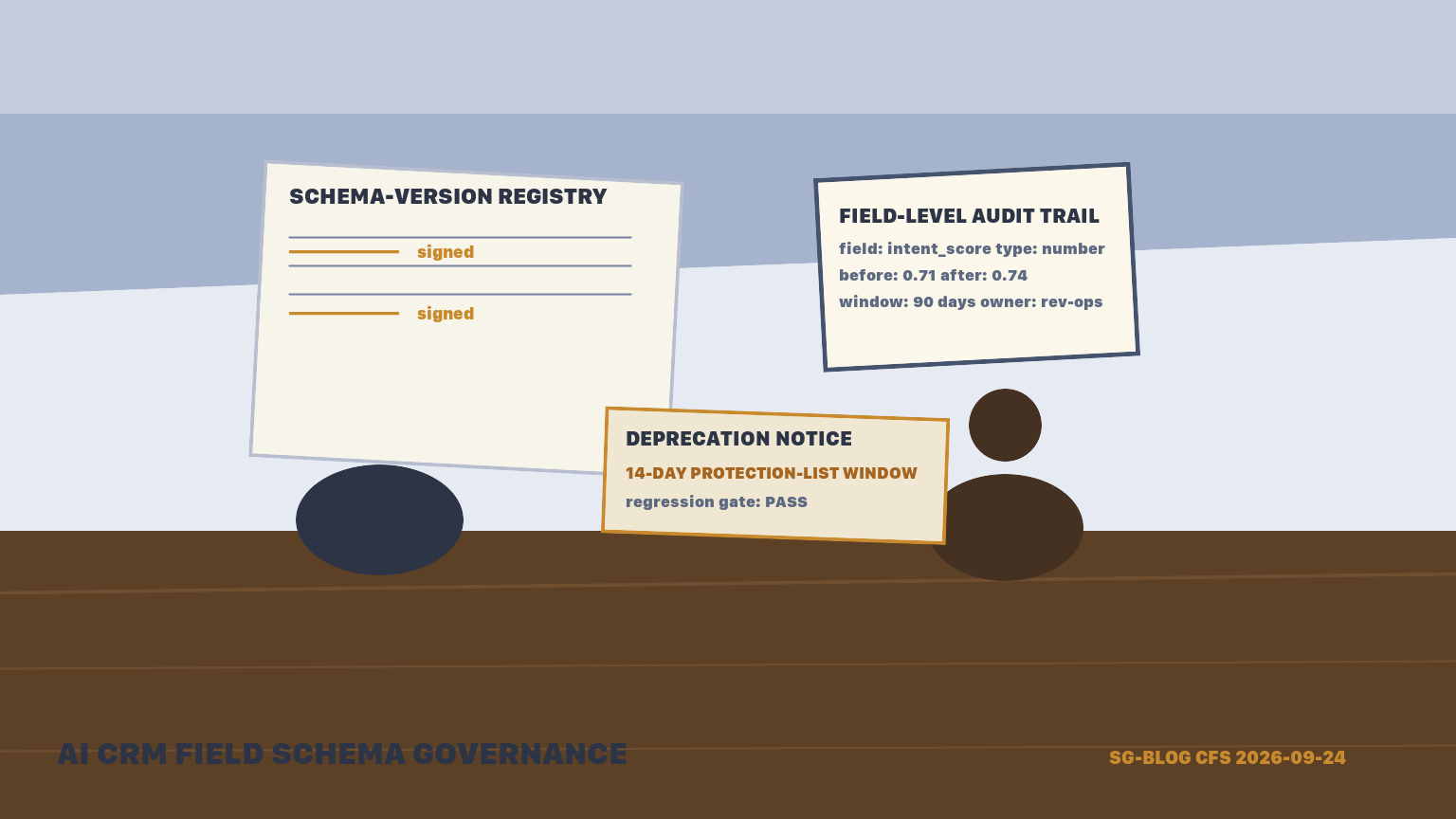
The deprecation protocol is the seventh control, and it is the one AI tooling stresses hardest because deprecation is where AI cleanup assistants are most aggressive. The NIST AI Risk Management Framework's GOVERN function workbook (2024) requires organizations using AI-driven schema evolution to document a deprecation protocol with a named accountable party, a field-level impact assessment before any schema change, and a 14-day notice window for fields on the named-account protection list. The protocol converts deprecation from deletion into retirement: the impact assessment lists every consumer of the field, the 14-day notice gives the account teams time to object and migrate, the named accountable party signs the retirement, and the field is archived in the registry rather than vanished. Fields on the named-account protection list — fields whose meaning is load-bearing for a specific strategic account's data contract — get the notice window every time, without exception, because an unannounced deprecation on a protected field is a data breach of trust even when it is not a breach of law.
Assembled, the controls form a weekly cadence with a per-change gate. Weekly: run the schema drift detection against the registry, review the findings with the named scorekeeper, and update the Article 30 record for any ratified change. Per change: write the registry entry with owner and signature, run the field-level impact assessment, execute the regression-test gate, observe the 14-day notice window for protected fields, and file the signed result in the audit trail. Quarterly: reconcile the registry against the live schema in full, review the 90-day audit-trail retention against the program's actual needs, and re-confirm the named-account protection list with the account teams. Every step writes an artifact, and the artifacts — registry, trails, drift reports, test results, signatures, notices — are the governance program in material form.
4. The failure modes are recognizable
The failure modes are recognizable. The first is the AI-assistant program: the CRM's built-in AI proposes field cleanups, an administrator accepts them in bulk during a busy week, and two months later a routing rule, a forecast column, or a compensation query returns numbers nobody can reconcile — the 56-percent, 60-day pattern from HubSpot's data, arriving on schedule. The second is the paper program: the registry exists and the scorekeeper is named, but the weekly drift pass is skipped because nothing seemed to change, which is precisely when AI tooling changes something quietly. The third is the undocumented deprecation: a field vanishes, a protected account's data contract silently loses a column, and the first person to notice is the customer. Each failure is prevented by a control above, and each control is a document, a cadence, and a name — none requires a platform migration to start.
For CRM and revenue-operations leaders standing the program up in the second half of 2026, the opening sequence is short. Stand up the schema-version registry this week and backfill it with the current schema as version one. Turn on field-level audit trails and set the retention window deliberately rather than by default. Schedule the weekly drift detection with a named owner, and wire the regression-test gate into whatever change process already exists — even a manual checklist is a gate. Name the data scorekeeper, publish the deprecation protocol with its 14-day protection-list notice window, and attach the Article 30 record to the registry so regulation-readiness rides along. Then run the first weekly review. The program will earn its keep the first time an AI-proposed schema change arrives, finds a gate in front of it, and has to become a signed decision.
5. This article practices the discipline it prescribes
This article practices the discipline it prescribes. Every quantitative claim above — the 56 percent and 60-day incident window and the weekly-drift recommendation from HubSpot, the 90-day change-history retention and registry recommendation from Salesforce, the Article 30 record requirements, and the NIST GOVERN deprecation protocol with its named party, impact assessment, and 14-day notice window — maps to a registered evidence item (ev-cfsg-001 through ev-cfsg-004), and no number appears in this article without one. That traceability standard is the same one the schema-version registry imposes on field changes: if the change cannot show its evidence and its signature, it does not ship. AI CRM field schema governance, reduced to one sentence, is the practice of making every AI-driven schema change a versioned, tested, signed, noticed decision — because the alternative, at a 56-percent incident rate inside 60 days, is not a risk; it is a schedule.
Frequently asked questions
What is AI CRM Field Schema Governance in 2026?
AI CRM field schema governance registers every AI-driven field change, gates it behind regression tests, and names the data scorekeeper who ratifies each schema version.
Where does governance start?
AI CRM field schema governance in 2026 is the written program that decides how AI-driven changes to CRM fields are registered in a version registry, audited at the field level, monitored for drift, gated behind regression tests, ratified by a named data scorekeeper, and deprecated on a documented pr
SOURCES & EDITORIAL NOTE
Editorial framework article. Claims cite named 2024-2026 industry sources; no vendor sponsorship.
- Salesforce Help Documentation: Salesforce Schema Builder — Field-Level Audit Trails and Schema-Version Registry Documentation
- HubSpot Academy / Knowledge Base: HubSpot CRM Schema Evolution Best Practices — Drift Detection and Governance (2024)
- Intersoft Consulting (GDPR-info.eu): GDPR Article 30 — Records of Processing Activities for AI-Schema Governance
- U.S. National Institute of Standards and Technology (NIST): NIST AI RMF Playbook — GOVERN Function Workbook for Schema-Governance Roles
MORE PRACTICAL IDEAS FOR B2B GROWTH
Related Articles



BUILD A PIPELINE THAT YOUR TEAM CAN SEE
Find more B2B buyers-without building a bigger team first. Tell us what you sell, which markets you want to reach, and what should count as a Qualified Lead. We'll help you build a repeatable path to the right buyers.