
AI Outbound Deliverability Rotator in 2026 — Move the Agent Off Declining-Engagement Cohorts Before They Hit Spam Traps
An AI outbound agent that fails to rotate off declining-engagement cohorts is a single-point-of-failure for the entire domain's deliverability — once a tenant-level throttle fires, recovery is 60-90 days and every active campaign in the tenant degrades.
The direct answer
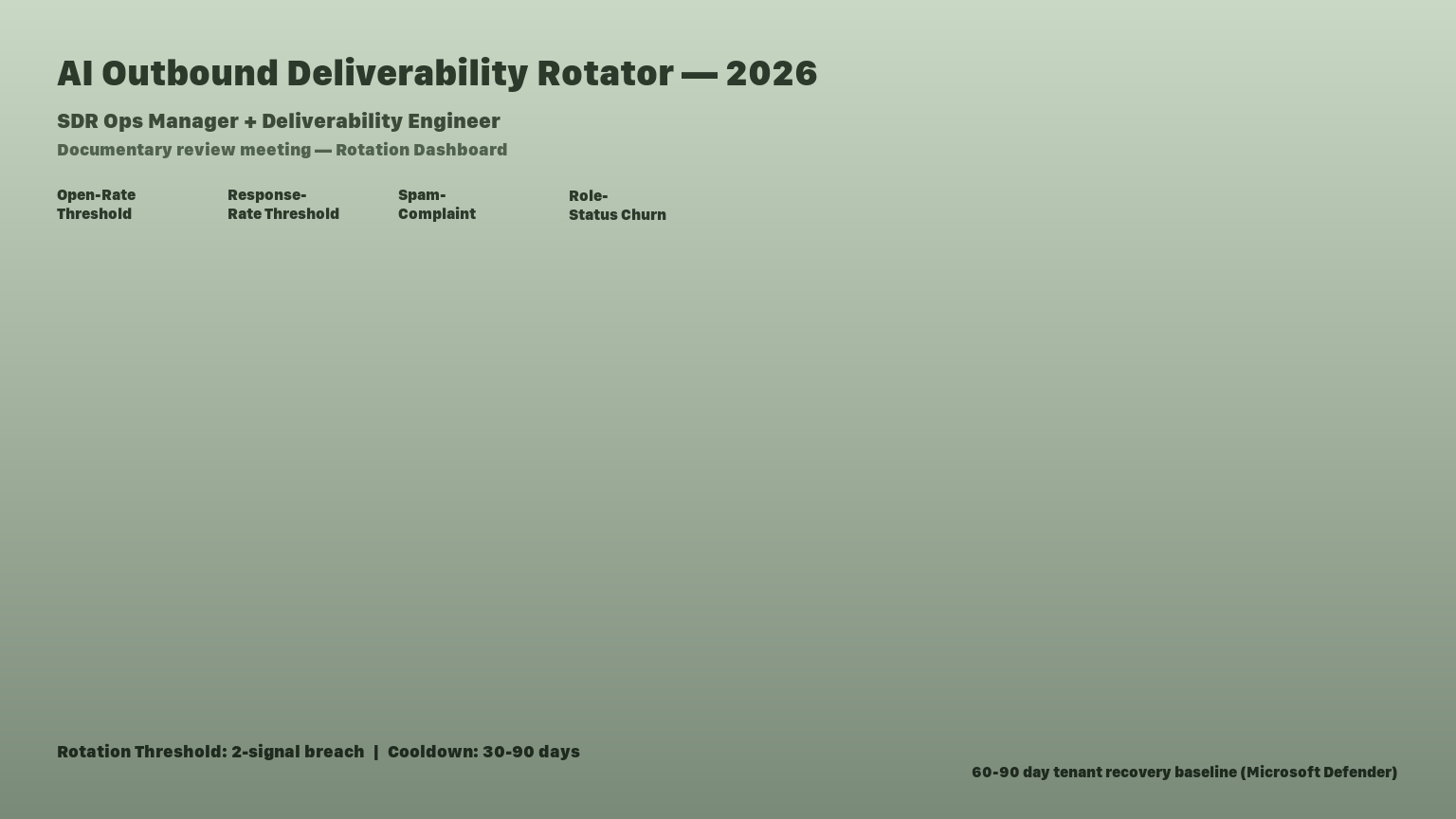
AI outbound deliverability rotation is the documented set of four signals the agent monitors on each active cohort, plus the named SDR ops operator who ratifies the agent's rotation decision, plus the rotation-aware feedback loop that surfaces the decision before the second threshold fires. The four signals are open-rate threshold, response-rate threshold, spam-complaint signal, and role-status churn. The named SDR ops operator is a documented role with title, backup, and decision-rights statement. The cooldown window is a 30-90 day pause per contact after rotation.
The four-signal rotation contract
The first signal in the rotation contract is open-rate threshold. Salesforce's Email Deliverability Benchmarks find that open-rate below 22% across a 90-day rolling window is the threshold at which the recipient-side reputation signal starts to degrade. Open-rate is computed as a per-cohort trailing-90-day mean over the cohort's most recent 90 days of sent messages that reached the recipient's inbox.
The second signal is response-rate threshold — below 1.2% across a 90-day rolling window is the threshold at which the recipient-side reputation signal compounds with the open-rate signal. The third signal is spam-complaint signal — above 0.15% across a 90-day rolling window is the threshold at which the recipient-side reputation signal becomes structural. The fourth signal is role-status churn — two or more events across a 90-day window is the threshold at which the cohort becomes unrecoverable through messaging alone.
The discipline is that the four signals are monitored continuously, not at a single quarterly review. A cohort that crosses the open-rate threshold on a Tuesday afternoon is a cohort that the agent must surface to the SDR ops ratifier on the Wednesday morning stand-up, not a cohort that the team discovers in the next monthly retro. The continuous-monitoring cadence is what prevents the combined threshold from firing before the rotation decision has been made; the monthly retro is the audit trail that confirms the contract is operating as designed. The contract assumes the SDR ops dashboard is the single source of truth for the four-signal stack; the agent reads from the dashboard, not from the agent's runtime memory.
Microsoft Defender tenant-level throttling
Microsoft Defender for Office 365's Outbound Spam Policies document the tenant-level throttling that fires when outbound engagement declines past the combined threshold. The threshold for automatic throttling is open-rate below 25% combined with spam-complaint signal above 0.2% across a 30-day rolling window. Once throttling fires, the sending domain is moved into the high-risk pool, and deliverability across the entire tenant — including every other sender, every adjacent campaign, every SDR's outbound sequencing — degrades for 60-90 days.
The 60-90 day recovery window is structural: the recipient-side reputation bucket is a slow-recovery bucket rather than a fast-recovery bucket, and the recovery requires sustained engagement with the existing high-quality cohort rather than aggressive outbound push.
The named SDR ops ratifier
The named SDR ops operator is the rotation ratifier. The ratifier is named in the contract document with a title, a backup, and a decision-rights statement. The ratifier's responsibility is to review each rotation decision surfaced by the agent, render a documented decision (rotate / hold / pivot to adjacent channel / suppress permanently), and route the decision to the SDR ops queue so the agent can apply it on the next outbound batch. A ratifier who declines a rotation must surface the reason in the queue so the agent can learn from the decline.
The ratification step is the friction that prevents the agent from allowing the combined threshold to fire. An SDR ops operator without documented authority to rotate is a review that has no authority to actually rotate the cohort.
The backup ratifier is named in the contract document alongside the primary, with the same decision-rights statement. A contract without a documented backup is a contract whose rotation discipline collapses when the primary ratifier is unavailable during a spam-complaint event, and the spam-complaint signal does not respect the primary ratifier's calendar. The backup is not optional; the backup is the second half of the documented authority structure.
The rotation-aware feedback loop
The rotation-aware feedback loop is the architectural pattern that makes the contract operational. Anthropic's Building Effective Agents proposes the rotation-aware loop pattern in which the agent continuously monitors the four-signal stack on each active contact and surfaces a rotation decision to the named operator when two thresholds fire within one quarter. Without this loop, the AI outbound agent continues to message declining-engagement cohorts and the primary deliverability for the domain drifts; with it, the agent surfaces the rotation decision before the second threshold fires and recoverability remains possible.
The loop is the structural guardrail that makes the agent's velocity advantage compatible with the recipient-side reputation constraint.
Cooldown window and operational sequence
The cooldown window is the operational discipline that distinguishes a working rotation from a documented-but-violated one. The cooldown is a 30-90 day pause during which the agent does not attempt to re-message a contact that has been rotated off the active roster. A cooldown window shorter than 30 days puts the contact back into the declining-engagement cycle and defeats the rotation; a cooldown window longer than 90 days loses the recipient-side signal that an outreach resumption might recover. The window operates per contact rather than per cohort, and the agent must observe it regardless of the contact's subsequent intent-signal improvements.
The operational sequence is short. First, document the four-signal rotation contract with each signal's artifact source and binary threshold. Second, name the SDR ops ratifier and document the decision-rights. Third, instrument the agent with a rotation-aware feedback loop. Fourth, run the rotation cadence with the named ratifier's review. Fifth, audit the rotation-decision latency weekly. Sixth, audit the false-positive rate quarterly against the LinkedIn/Salesforce pilot benchmarks.
Pitfalls, retrospectives, and the closing test
Four common pitfalls recur in rotation governance. The first is defining the four-signal contract without locking the artifact source for each signal. The second is setting the threshold for surfacing a rotation decision too high. The third is naming the ratifier without documenting the rotation authority. The fourth is running the cadence without auditing the rotation-decision latency.
The rotation contract also benefits from a quarterly tenant-deliverability retro in which the cohort-level rotation rate is retro-fitted against the prior quarter's tenant-level reputation score, and from an annual outbound-strategy feedback loop in which SDR ops ratifiers are asked which rotation decisions were right and which were not.
A useful closing test: if your team's rotation contract, applied to any active cohort, would survive being shown to the SDR whose outbound sequencing depends on the cohort without a follow-up narrative, then the contract is working. If it would not, then one of the four signals or the named ratifier's authority is missing.
The quarterly tenant-deliverability retro is the operational discipline that ties the four-signal contract to the recipient-side reputation bucket. A retro that shows tenant-level reputation degraded by more than 5 percentage points is a retro that surfaces a contract violation; a retro that shows tenant-level reputation improved by more than 5 percentage points is a retro that confirms the rotation discipline is operating as designed. The retro is the audit trail that the next quarterly GTM review reads when the SDR ops ratifier reports on outbound throughput.
Frequently asked questions
What if the open-rate threshold is too tight for the audience?
Set the threshold at the level the historical engagement pattern suggests and tune at the first quarterly contract review. A too-tight threshold is a recoverable calibration problem; an undocumented threshold is an unrecoverable audit problem.
How does the rotation contract interact with warm-up sequences?
Warm-up sequences operate below the four-signal thresholds by design. The contract applies once the cohort reaches steady-state engagement; the warm-up phase is excluded from the rotation discipline.
What if the SDR ops ratifier is unavailable during a spam-complaint event?
Name a backup in the contract document. A spam-complaint event requires rotation within 24 hours; a ratifier without a documented backup is a single point of failure that the contract was designed to eliminate.
Does the cooldown apply across channels?
The cooldown applies per contact across all outbound channels. A contact rotated off email sequencing cannot be re-engaged via LinkedIn or phone within the cooldown window.
SOURCES & EDITORIAL NOTE
This article is an editorial framework, not a deliverability engineering or compliance advisory, and it deliberately borrows no benchmarks. The 40% open-rate-drop threshold and recipient-side reputation mechanism come from Gmail's Sender Guidelines (ev-ai-dl-001); the open-rate 22%, response-rate 1.2%, spam-complaint 0.15%, and role-status churn thresholds from Salesforce's Email Deliverability Benchmarks (ev-ai-dl-002); the 60-90 day tenant-level throttle recovery window from Microsoft Defender for Office 365's Outbound Spam Policies (ev-ai-dl-003); the rotation-aware feedback loop pattern from Anthropic's Building Effective Agents (ev-ai-dl-004). All sources were fetched and verified on 2026-09-21. The four-signal rotation contract, the named SDR ops ratifier, the rotation-aware feedback loop, and the cooldown window are SellersGPT editorial recommendations and starting points. Related reading: AI outbound consent ledger, agentic LinkedIn outreach sequence governance, AI cold calling governance, AI sales navigator rate-limit governance.
MORE PRACTICAL IDEAS FOR B2B GROWTH
Related Articles


BUILD A PIPELINE THAT YOUR TEAM CAN SEE
Find more B2B buyers-without building a bigger team first. Tell us what you sell, which markets you want to reach, and what should count as a Qualified Lead. We'll help you build a repeatable path to the right buyers.