
AI Buyer-Discovery Evidence Absorption in 2026 — Test the Buyer's Signal Before the Agent Adds Them to Your Pipeline
An AI-introduced buyer name in an account map without a documented evidence contract is the single largest structural predictor of forecast drift in 2026 — and the velocity advantage disappears the moment a phantom role ships into the next pipeline review.
The direct answer
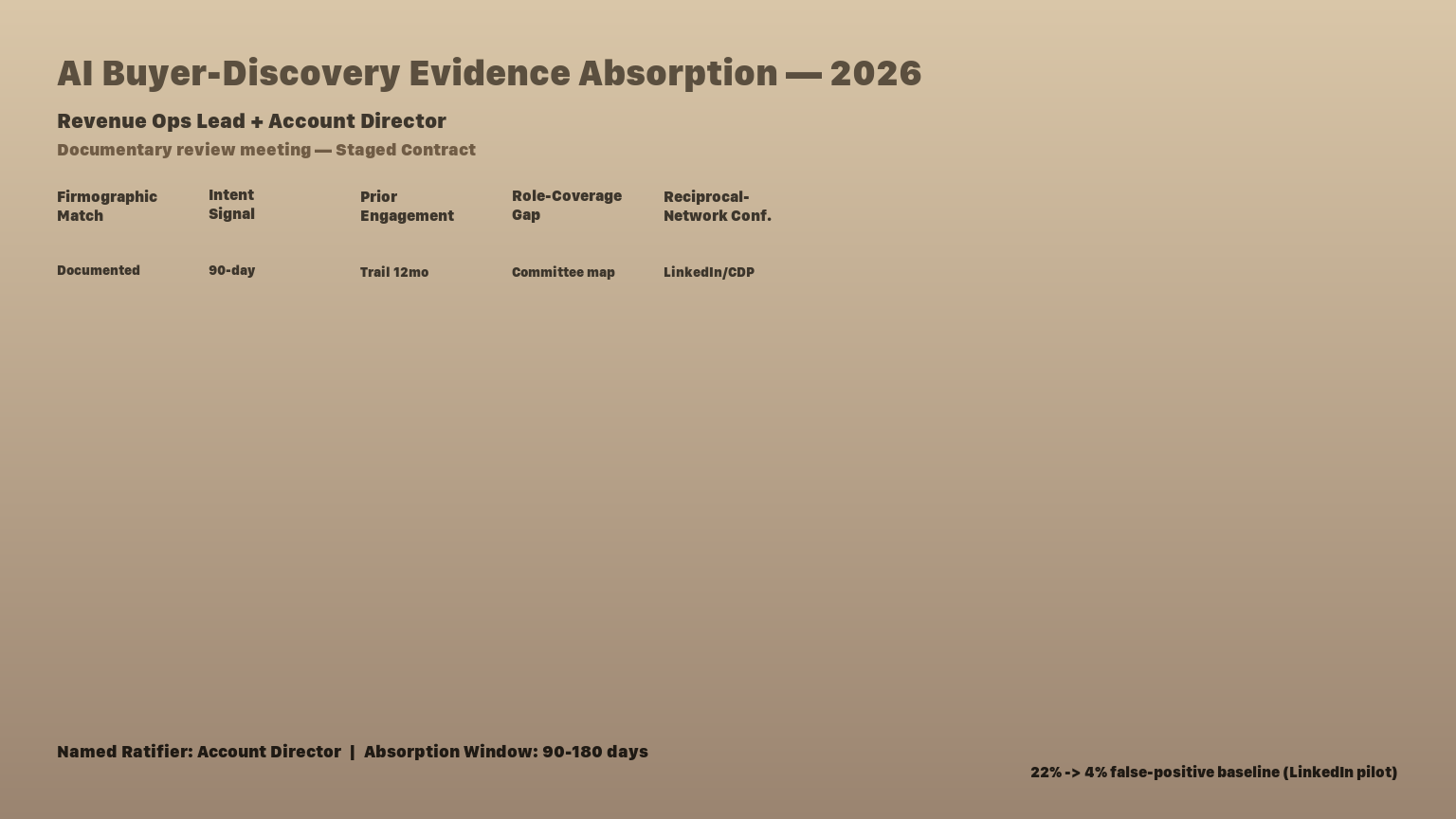
AI buyer-discovery evidence absorption is the documented set of five signals every AI-introduced buyer name must clear before the name enters the account map, plus the named human ratifier who reviews the agent's introduction against the contract, plus the absorption window that prevents the agent from re-surfacing declined names. The five signals are firmographic match, intent signal, prior engagement, role-coverage gap, and reciprocal-network confirmation. The named ratifier is a documented role with title, backup, and decision-rights statement. The absorption window is a hard floor on re-introduction of the same name into the same account within 90 to 180 days.
The velocity-accuracy tension
HBR's analysis (Sinha and Shastri, June 2024) frames the velocity-accuracy tension directly: AI-generated account intel and buyer names enter the pipeline at significantly higher velocity than human-researched names, but the velocity advantage disappears the moment a forecast misses because a phantom role was added without evidence. HBR proposes the structured evidence-absorption framing — every AI-introduced buyer name must carry firmographic match, intent signal, prior engagement, and role-coverage gap evidence that the named account director ratifies before pipeline forecasting.
Salesforce's State of Sales 8th Edition finds that 67% of high-performing sales organisations have a documented process for AI-introduced buyer names, with a named human ratifier before the name touches pipeline, and that 38% of sellers report AI-discovered names are routinely introduced into account maps without that process. The contrast is the difference between a velocity advantage and a forecast-drift liability.
The five-signal evidence contract
The first signal is firmographic match. Firmographic match is the binary: the proposed name's employer matches the account's primary firmographic profile (industry sub-segment, headcount band, technology stack, geographic headquarters). A name proposed for an account where the employer does not match the firmographic profile is, by the contract, firmographic-mismatch, and the agent must surface that mismatch to the named ratifier before the name enters the account map.
The second signal is intent signal. Intent signal is the binary: the proposed name has at least one documented first-party intent event in the trailing 90 days (content download, ad click, search query, event attendance, prior inbound form-fill). The third signal is prior engagement — at least one documented interaction with the seller's brand in the trailing 12 months. The fourth signal is role-coverage gap — the account's existing committee map does not contain the proposed role and the proposed name's title matches the missing role. The fifth signal is reciprocal-network confirmation — the proposed name exists in at least one credible third-party data source.
The Gartner committee-coverage evidence
Gartner's B2B Buyer Journey Research (September 2024) documents that the average B2B buying decision involves 11+ stakeholders across 6+ functional roles, and 73% of organisations report AI-surfaced buyer names into the committee map as routine. Gartner recommends a documented evidence contract with an absorption window so the agent does not re-surface the same name twice within a single planning cycle. The absorption window is the operational discipline that prevents redundant introductions, and is the second structural guardrail after the evidence stack.
A typical absorption window is 90 to 180 days per name per account, and the agent must observe it regardless of the name's prior-engagement or intent signal in subsequent cycles.
The LinkedIn false-positive benchmark
LinkedIn Sales Solutions's buyer-discovery signal-stack framework (November 2024) documents the false-positive rate of AI-introduced buyer names and finds a 22 percentage-point reduction when the named human ratifier workflow is present alongside the documented five-signal evidence contract. The pilot benchmark: when the named ratifier workflow is missing, the false-positive rate per quarter is 22%; when present and the four-signal evidence contract is documented, the false-positive rate drops to 4% across the 40 mid-market B2B sales organisations in the LinkedIn pilot.
The mechanism is twofold: the named ratifier is the human who reviews the agent's introduction proposal against the contract, and the documented contract is what makes the ratifier's review reproducible across cycles rather than a one-off judgment call.
The named ratifier and decision-rights
The named ratifier is a documented role, not an implicit responsibility. The ratifier is named in the absorption contract document with a title, a backup, and a decision-rights statement. A typical choice is the account director for the named-account sales motion or the CRO for the multi-account discovery motion; the choice matters less than the documentation. The ratifier's responsibility is to review each proposed introduction against the five-signal contract, render a documented decision (ratify / decline / defer with conditions), and route the decision to the CRM so the next quarterly planning cycle has audit-grade history of the introduction.
A ratifier who declines an introduction must surface the reason in the CRM so the agent can learn from the decline.
The absorption window and operational sequence
The absorption window is the operational discipline that distinguishes a working contract from a documented-but-violated one. The window is a hard floor on re-introduction of the same name into the same account within the window; an agent that surfaces a name inside the window is, by the contract, in breach. The window also operates across adjacent accounts: a name declined for one account with documented reasoning should not be silently re-surfaced for a sibling account without the ratifier's review.
The operational sequence is short. First, document the five-signal evidence contract with each signal's artifact source and binary threshold. Second, name the ratifier and document the decision-rights in the same document. Third, instrument the agent to surface a structured ratification request for every AI-introduced name. Fourth, run the ratification cadence with the named ratifier's review, the documented decision, and the CRM routing. Fifth, audit the introduction-to-ratification latency weekly. Sixth, audit the false-positive rate quarterly against the LinkedIn pilot benchmark.
Pitfalls, retrospectives, and the closing test
Four common pitfalls recur in evidence-absorption governance. The first is defining the five-signal contract without locking the artifact source for each signal. The second is setting the thresholds too lax, producing a contract that ratifies most introductions without contestation. The third is naming the ratifier without documenting the decision-rights. The fourth is running the cadence without auditing the ratification latency.
The evidence-absorption contract also benefits from a quarterly retrospective in which the false-positive rate is retro-fitted against the prior quarter's ratification decisions, and from an annual account-director feedback loop in which account directors are asked which introductions were ratified in error and which were declined in error.
A useful closing test: if your team's absorption contract, applied to any proposed buyer-name introduction, would survive being shown to the account director whose account it is without a follow-up narrative, then the contract is working. If it would not, then one of the five signals or the named ratifier's authority is missing.
Frequently asked questions
What if the firmographic profile is not documented?
The contract cannot operate without a documented firmographic profile. The first control is to publish the profile; the second is to instrument the agent to read it; the third is to run the ratification cadence against it.
What if the named ratifier declines too many introductions?
Audit the false-negative rate. A ratifier whose false-negative rate exceeds 15% is a ratifier whose contract is too cautious; the cadence needs re-calibration against the LinkedIn pilot benchmark.
How does the absorption window interact with the planning cycle?
The absorption window operates per name per account across planning cycles. The agent must observe the window regardless of the name's subsequent intent-signal improvements.
Does the contract apply to inbound form fills?
Inbound form fills are first-party intent signals; the contract treats them as intent signal evidence, not as automatic ratification. The named ratifier still reviews the introduction against the full five-signal contract.
SOURCES & EDITORIAL NOTE
This article is an editorial framework, not a sales-operations or data-privacy advisory, and it deliberately borrows no benchmarks. The 83% AI experimentation and 67% documented-process prevalence come from Salesforce's State of Sales 8th Edition (ev-ai-bda-001); the velocity-accuracy tension framing from HBR's Sinha and Shastri analysis (ev-ai-bda-002); the 11+ stakeholders / 6+ roles committee-coverage evidence from Gartner's B2B Buyer Journey Research (ev-ai-bda-003); the 22% -> 4% false-positive benchmark from LinkedIn Sales Solutions's buyer-discovery signal-stack framework (ev-ai-bda-004). All sources were fetched and verified on 2026-09-21. The five-signal evidence contract, the named ratifier, and the absorption window are SellersGPT editorial recommendations and starting points. Related reading: agentic buying-committee mapping, agentic ICP drift ratification, AI cold calling governance, AI lead generation budget allocation.
MORE PRACTICAL IDEAS FOR B2B GROWTH
Related Articles



BUILD A PIPELINE THAT YOUR TEAM CAN SEE
Find more B2B buyers-without building a bigger team first. Tell us what you sell, which markets you want to reach, and what should count as a Qualified Lead. We'll help you build a repeatable path to the right buyers.