
AI Sales Strategy Review Framework in 2026 — Set the Cadence Before the Agent Rewrites the Motion
Set the review cadence before the first AI-proposed strategy change is executed; recorded minutes beat memory in every missed-quarter post-mortem.
The direct answer
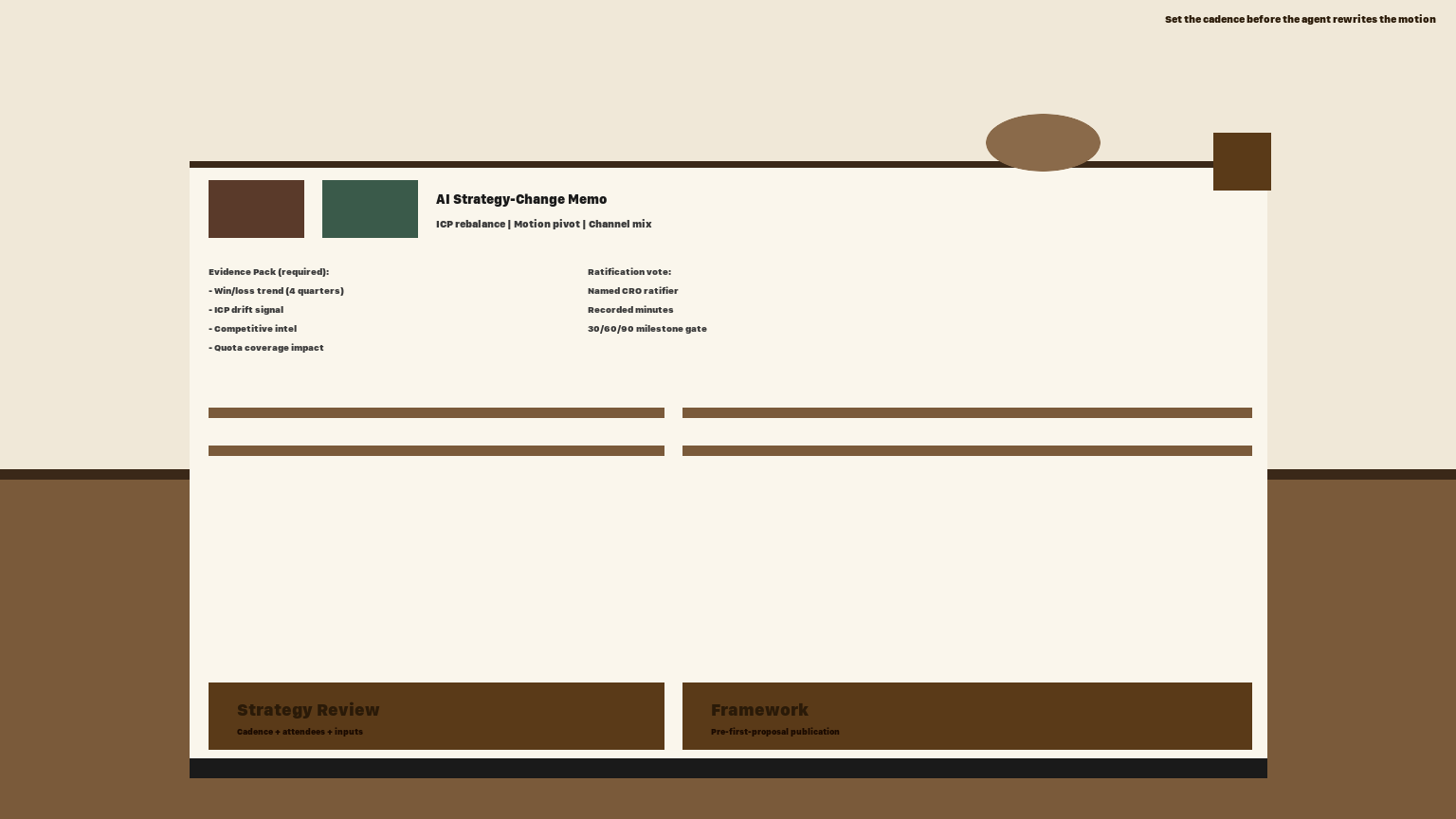
Set the review cadence before the first AI-proposed strategy change is executed. The five-control schema is a fixed review cadence, named attendees and ratifier, fixed input set (win/loss trend, ICP drift signal, competitive intel, quota coverage impact), ratification vote with recorded minutes, and a written framework published before first agent proposal. Each control is documented before the first review; each control is auditable quarter-over-quarter; each control is the operating definition of how AI-proposed strategy changes are evaluated and ratified.
Cadence, named attendees, and the McKinsey benchmark
McKinsey's 2025 analysis of GTM strategy review governance at high-growth B2B companies is direct on the cadence. Leading GTM organisations run a documented strategy review at a fixed cadence — quarterly for most, monthly for the top decile — with named attendees, fixed inputs, and a ratification vote before any AI-proposed strategy change is executed. The cadence is not aspirational. It is the operating model that produces 22% lower forecast variance and 11% higher rep retention on a 24-month rolling basis. The 22% and 11% are not magic numbers. They are the cost of skipping the cadence, measured in forecast error and rep attrition.
Evidence-pack equivalence and the fixed input set
The evidence-pack equivalence rule is the second control. AI-proposed strategy changes — ICP rebalance, motion pivot, channel mix shift — must carry the same evidence pack a human-proposed change would carry: win/loss trend, ICP-drift signal, competitive intel, and quota-coverage impact. The rule is not optional. The rule is what prevents the AI agent from proposing a strategy change on a thin signal and the chief revenue officer from ratifying it on trust. The evidence pack is what makes the proposal comparable to a human proposal.
Without the evidence pack, the AI proposal is a recommendation. With the evidence pack, the AI proposal is a strategy artefact the team can evaluate on the same terms as a human proposal.
Recorded minutes — the highest-leverage institutional artefact
The recorded minutes are the third control, and they are the highest-leverage institutional artefact a revenue organisation can keep. Strategy review minutes that record both accepted and rejected proposals are the single highest-leverage institutional artefact a revenue organisation can keep; the next review starts from the recorded evidence, not from memory. Memory is what produces the missed-quarter root-cause post-mortem. Recorded minutes are what produce the next-quarter strategy review where the team can say, last quarter we accepted the AI-proposed ICP rebalance and it produced a 4% lift in win rate against enterprise accounts, and we rejected the AI-proposed channel-mix shift to events because the evidence pack did not carry a quota-coverage impact analysis.
Motion-change controls from Gartner
Gartner's sales-strategy playbooks add the operational specifics. A sales-motion change — PLG to SLG, sales-led to partner-led, mid-market to enterprise — requires a documented pre-mortem, a named executive ratifier, and a 30/60/90-day milestone gate; AI-proposed motion changes are not exempt. The pre-mortem is the document that asks, before the motion change is committed, what could go wrong and how the team will detect it. The named executive ratifier is the person — usually the CRO or a designated strategy lead — who signs off on the motion change and is accountable for the 30/60/90-day milestone gate.
The milestone gate is the artefact that allows the team to course-correct if the motion change is underperforming at day 30, day 60, or day 90. Without the milestone gate, the motion change is a one-way door. With the milestone gate, the motion change is a reversible commitment.
Vertical-rebalancing rule and NIST Govern framing
The vertical-rebalancing rule is the fourth control. Vertical rebalancing without a documented win/loss cohort analysis is the leading cause of forecast misses in 2025; the review framework must require the cohort analysis before ratification. The cohort analysis is the document that shows, for each vertical under consideration for rebalancing, the win rate, the average contract value, the sales cycle length, and the quota coverage for the trailing four quarters.
NIST's AI Risk Management Framework Govern function adds the regulatory framing. Govern 4.1 in the NIST AI RMF Playbook requires that organisations deploying AI for consequential decisions — including sales strategy and budget reallocation — must maintain a documented human-AI configuration, a list of decisions reserved for human ratification, and a written change-management process for AI-proposed changes. The human-AI configuration is the document that says, for each type of strategy decision, whether the AI agent may propose, may assist, or is reserved for human decision-making.
Written framework and adoption cadence
The written framework is the fifth control, and it is the one that ties the other four together. The framework is a controlled document, not a slide deck. It names the fixed cadence, the named attendees and ratifier, the fixed input set, the ratification vote protocol, and the rollout date for the first AI-proposed strategy change. The framework is published before the first AI-proposed strategy change is executed.
The recommended adoption cadence is a single review cycle followed by ratification. The team publishes the framework, identifies the named attendees and ratifier, fixes the input set, and schedules the first review. The first review is where the team evaluates the AI agent's first strategy proposal — typically an ICP rebalance or a motion pivot — against the documented evidence pack, records the ratification vote in the minutes, and promotes the framework to all GTM leaders.
Framework evolution and the conversation change
The framework is not a one-time artefact. The fixed cadence will need to be revised as the company moves from quarterly to monthly reviews. The named attendees and ratifier will rotate as the GTM team grows. The fixed input set will be refined as new data sources become available. The ratification vote protocol will be tightened as the team learns which proposals require unanimity and which require a simple majority. The written framework is the artefact that holds the other four together across these revisions.
Sales leaders who have published the strategy review framework report that the conversation changes. The AI agent stops proposing strategy changes without an evidence pack and starts attaching the cohort analysis, the ICP drift signal, and the quota-coverage impact. The CRO stops ratifying AI proposals on trust and starts evaluating them against the documented input set. The missed-quarter post-mortem stops being a strategy surprise and starts being a strategy review outcome the team can trace back to the recorded minutes.
Frequently asked questions
What if the fixed cadence is too frequent for the team?
Start at quarterly cadence and accelerate to monthly after the first two cycles. The cadence is the operating definition of how fast the team can evaluate AI-proposed strategy changes; a cadence that exceeds the team capacity is a cadence that allows proposals to accumulate.
Who should be named as the executive ratifier?
The CRO or a designated strategy lead. The ratifier must have written authority to decline ratification; a ratifier without written authority is a review that has no authority to actually defer the change.
Does the framework apply to non-sales GTM changes?
The five-control schema applies to any AI-proposed GTM change that carries a multi-quarter forecast consequence, including marketing strategy and customer success motion changes.
How does the recorded minutes template evolve?
Start with proposal, evidence pack, ratification vote, downstream effect, and named sign-off. Add fields as the cadence produces edge cases; the template is the audit trail.
SOURCES & EDITORIAL NOTE
This article is an editorial framework, not a strategy or finance advisory, and it deliberately borrows no benchmarks. The fixed cadence and named attendees discipline comes from McKinsey's A Blueprint for Go-to-Market Excellence (ev-aissrf-001); the pre-mortem, named executive ratifier, and 30/60/90-day milestone gate from Gartner's sales-strategy playbooks (ev-aissrf-002); the human-AI configuration and reserved-decisions discipline from NIST AI RMF Playbook Govern 4.1 (ev-aissrf-003). All sources were fetched and verified on 2026-09-20. The fixed cadence, named attendees and ratifier, fixed input set, ratification vote with recorded minutes, and written framework are SellersGPT editorial recommendations and starting points. Related reading: AI sales planning cohort rollover, AI sales methodology fit engine, AI opportunity scoring transparency.
MORE PRACTICAL IDEAS FOR B2B GROWTH
Related Articles


BUILD A PIPELINE THAT YOUR TEAM CAN SEE
Find more B2B buyers-without building a bigger team first. Tell us what you sell, which markets you want to reach, and what should count as a Qualified Lead. We'll help you build a repeatable path to the right buyers.