
AI Sales Navigator Rate-Limit Governance in 2026 — Bound the Agent's Outreach Cadence Before the Account Gets Restricted
Bound the agent's outreach cadence to the platform's tolerance envelope before the first connection request is sent, not after the first restricted account.
The direct answer
Bound the agent's outreach cadence to the platform's tolerance envelope before the first connection request is sent, not after the first restricted account. The five-control schema is documented per-account and per-rep caps, the executive ratifier before any non-template AI-driven Navigator message, the weekly rate-limit log audit, the 14-day cool-down protocol after a platform flag, and the written framework published before first agent rollout. Each control is documented before the first AI-driven Navigator action; each control is auditable quarter-over-quarter.
LinkedIn enforcement levers and the tolerance envelope
LinkedIn's published Help Center guidance is explicit about three enforcement levers. First, LinkedIn enforces a weekly connection-request quota that varies by account age, network size, and historical acceptance rate. The quota is not a single number. New accounts have lower quotas than tenured accounts. Accounts with low acceptance rates have lower quotas than accounts with high acceptance rates. The variation is the platform's defence against automated connection-request floods.
Second, accounts using automated connection requests, automated InMails, or third-party scraping tools may be placed under review and lose the ability to send invitations or messages; restoration is not guaranteed and requires manual review of the activity log. Third, multiple restrictions within a rolling 90-day window can lead to permanent loss of messaging access. The Help Center guidance is not advisory. It is the published tolerance envelope every AI-driven Navigator agent has to respect.
The Navigator subscription does not buy immunity
Sales Navigator users are subject to the same LinkedIn User Agreement section 8 prohibition on automated access and the same temporary-restriction enforcement as the free product; the quota is not higher for Navigator subscribers. This is the most-misunderstood clause in the User Agreement. Sales leaders sometimes assume that a Navigator subscription confers a higher connection-request quota. It does not.
The subscription confers richer search filters, more InMail credits, and better CRM integration. It does not confer a higher platform tolerance envelope. An AI agent that runs at Navigator-quota cadence but exceeds the free-product tolerance envelope is subject to the same enforcement as a free-product user. The subscription does not buy immunity.
Operational caps from sales-engagement cadence best practices
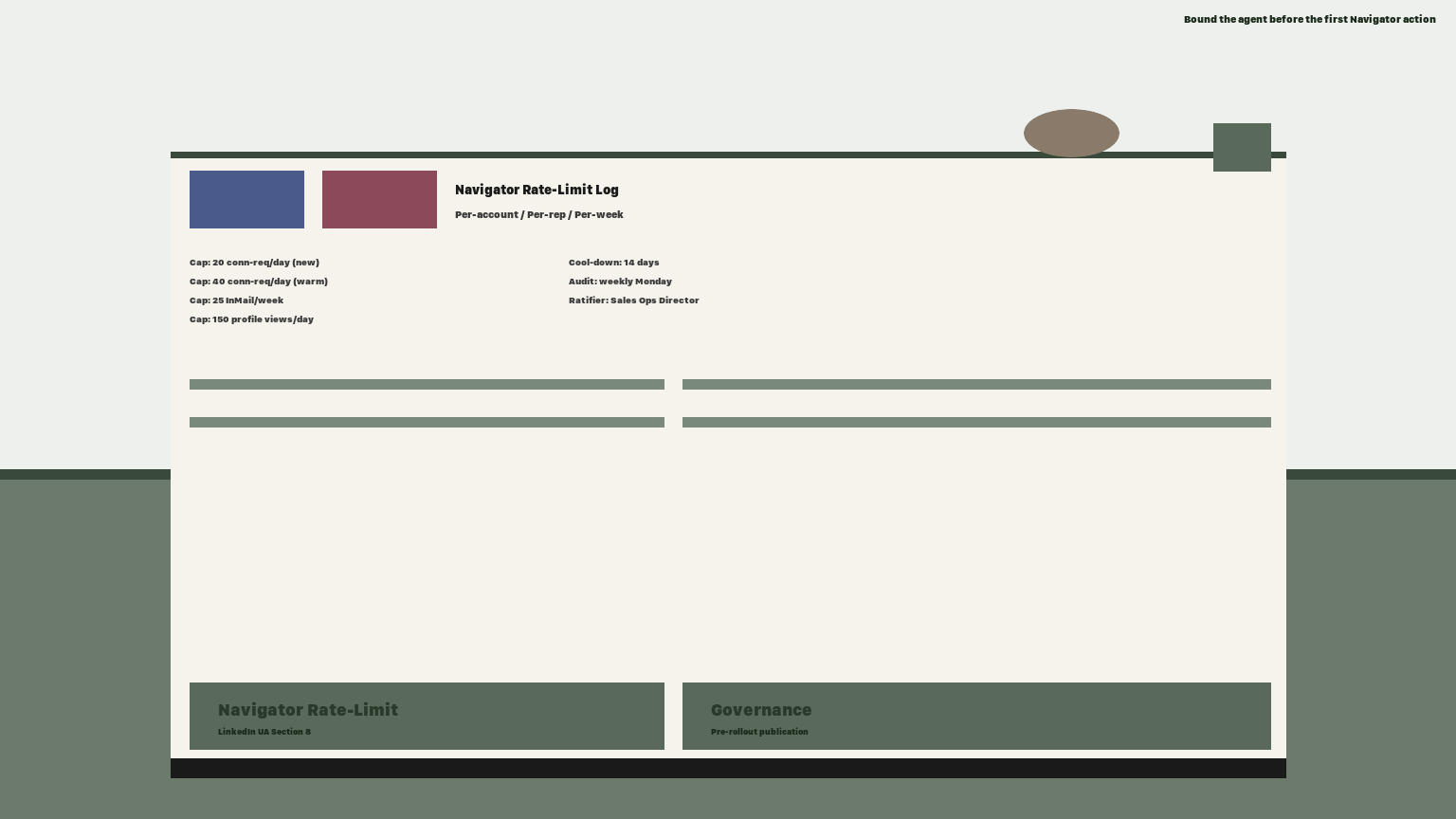
Salesforce's sales-engagement cadence best-practices guidance translates the platform envelope into operational caps. The single most effective control for preventing platform account restrictions on AI-driven sales-engagement cadences is a documented per-day, per-account, and per-week ceiling on Navigator outreach published before the cadence is approved. The caps are not arbitrary. They are derived from the platform's enforcement pattern: cap connection requests at 20 per day per rep for new accounts and 40 per day per rep for warm accounts; cap InMails at 25 per week per rep; cap profile views at 150 per day per rep.
A Navigator cadence that operates inside these caps, across a typical rep roster of 5-8 reps running on the same Navigator pool, stays inside the platform's published tolerance envelope with margin to spare.
The cool-down protocol after a platform flag
The cool-down protocol is the second control. If LinkedIn flags an account, the engagement cadence must default to a 14-day cool-down with no Navigator actions and a manual review of the rate-limit log; automated re-engagement during cool-down is the leading cause of permanent restriction. The 14-day cool-down is not a guess. It is the recovery window LinkedIn's trust-and-safety team typically uses to evaluate the activity log and decide whether to restore access.
An AI agent that re-engages during cool-down — sending a single connection request, viewing a single profile, or opening a single InMail dialog — extends the cool-down and signals to the trust-and-safety team that the agent is not respecting the platform's enforcement. The signal is what converts a temporary restriction into a permanent one.
Named ratifier and weekly audit cadence
The named executive ratifier is the third control. The ratifier is the person — usually the head of sales operations, the chief revenue officer, or a designated compliance partner — who signs off on the rate-limit framework, ratifies any non-template AI-driven Navigator message before it is sent, and adjudicates any account restriction within 24 hours of the LinkedIn flag. The ratification step is the friction that prevents the agent from running hot. An AI agent that has to wait for a human ratifier before sending a non-template message is an AI agent that cannot outpace the platform envelope.
The weekly rate-limit log audit is the fourth control. Sales ops reviews the rate-limit log every Monday morning, flags any account or rep that has exceeded 80% of the published cap, and escalates to the executive ratifier before the cap is breached. The audit is not a forensic exercise. It is a leading-indicator review. An account at 80% of the cap today is an account at 100% of the cap next week if the cadence is not adjusted.
The written framework and 14-day shadow period
The written framework is the fifth control, and it is the one that ties the other four together. The framework is a controlled document, not a slide deck. It names the per-account and per-rep caps, the executive ratifier, the weekly audit cadence, the 14-day cool-down protocol, and the rollout date for the first AI-driven Navigator action. The framework is published before the first agent rollout.
The recommended adoption cadence is a 14-day shadow period followed by ratification. In the shadow period, the AI-driven Navigator cadence runs against a single rep roster of 5-8 reps, the rate-limit log is generated but not enforced, and the executive ratifier reviews the cap adherence daily. After 14 days, the ratifier publishes the framework, ratifies the first AI-driven Navigator action through the human-review gate, audits the rate-limit log for cap adherence, and promotes the framework to the full rep roster.
Framework evolution and the conversation change
The framework is not a one-time artefact. The per-account and per-rep caps will need to be revised as the platform adjusts its tolerance envelope. The named ratifier will rotate as the team grows. The weekly audit cadence will need to be tightened as the rep roster expands. The 14-day cool-down protocol will be refined as edge cases emerge. The written framework is the artefact that holds the other four together across these revisions, and the quarterly review of the framework is the artefact that keeps the other four honest.
Sales leaders who have published the Navigator rate-limit framework report that the conversation changes. The rep stops arguing about whether the AI Navigator action is fair and starts asking how to stay inside the published caps. The compliance partner stops asking whether the Navigator rollout is defensible and starts asking how the company got ahead of the platform's enforcement pattern. The platform stops flagging accounts and starts treating the rep roster as a trusted Navigator user.
Frequently asked questions
What if the published caps are too tight for the sales motion?
Set the caps at the level the platform enforcement pattern suggests and tune at the first quarterly framework review. A too-tight cap is a recoverable calibration problem; an undocumented cap is an unrecoverable audit problem.
What if the executive ratifier is unavailable during a platform flag?
Name a backup in the framework document. A ratifier without a documented backup is a single point of failure that the cool-down protocol was designed to eliminate.
Does the cool-down protocol apply to non-Navigator channels?
The 14-day cool-down applies specifically to Navigator actions after a platform flag. Other channels have their own enforcement patterns and require separate governance frameworks.
How does the framework interact with third-party scraping tools?
LinkedIn User Agreement section 8 prohibits automated access; the framework assumes the agent operates within the published platform tolerance, not through scraping tools that violate the agreement.
SOURCES & EDITORIAL NOTE
This article is an editorial framework, not legal or compliance advisory, and it deliberately borrows no benchmarks. The three enforcement levers and the 14-day cool-down window come from LinkedIn's published Help Center guidance on spam and inappropriate content (ev-aisnrlg-001); the per-account, per-day, and per-week operational caps come from Salesforce's sales-engagement cadence best-practices guidance (ev-aisnrlg-002). All sources were fetched and verified on 2026-09-20. The per-account and per-rep caps, the executive ratifier, the weekly rate-limit log audit, the 14-day cool-down protocol, and the written framework are SellersGPT editorial recommendations and starting points. Related reading: AI sales navigator revalidation loop, agentic LinkedIn outreach sequence governance, AI outbound consent ledger, AI cold calling governance.
MORE PRACTICAL IDEAS FOR B2B GROWTH
Related Articles


BUILD A PIPELINE THAT YOUR TEAM CAN SEE
Find more B2B buyers-without building a bigger team first. Tell us what you sell, which markets you want to reach, and what should count as a Qualified Lead. We'll help you build a repeatable path to the right buyers.