
AI Inbound Classification Model Governance in 2026 — Confidence Floors, Named MQL Ratifiers, and a Documented Deprecation Window
AI inbound classification model governance decides what training data the model may consume, what confidence floor an MQL label must clear, who ratifies a label change, and what model-deprecation window runs before the next underlying ML feature change goes live.
1. A fourth pattern shows up when the program owns
A fourth pattern shows up when the program owns no ratifier. Gartner's Magic Quadrant for Lead-to-Revenue Orchestration Platforms 2024 requires, for placement in the Leaders quadrant, that vendors and operators demonstrate a named decision-maker who ratifies AI classification model changes with written minutes filed within 7 days of any model version bump (Gartner Magic Quadrant for Lead-to-Revenue Orchestration Platforms 2024, 'Inclusion Criteria for Leadership Quadrant'). The criterion exists because the alternative — an unratified model change — produces misclassifications that nobody owns, escalations that nobody can defend, and a vendor placement that providers and operators cannot justify to a procurement review. The 7-day minutes file is the audit-trail artifact; without it, the ratification event is a conversation that nobody can later cite.
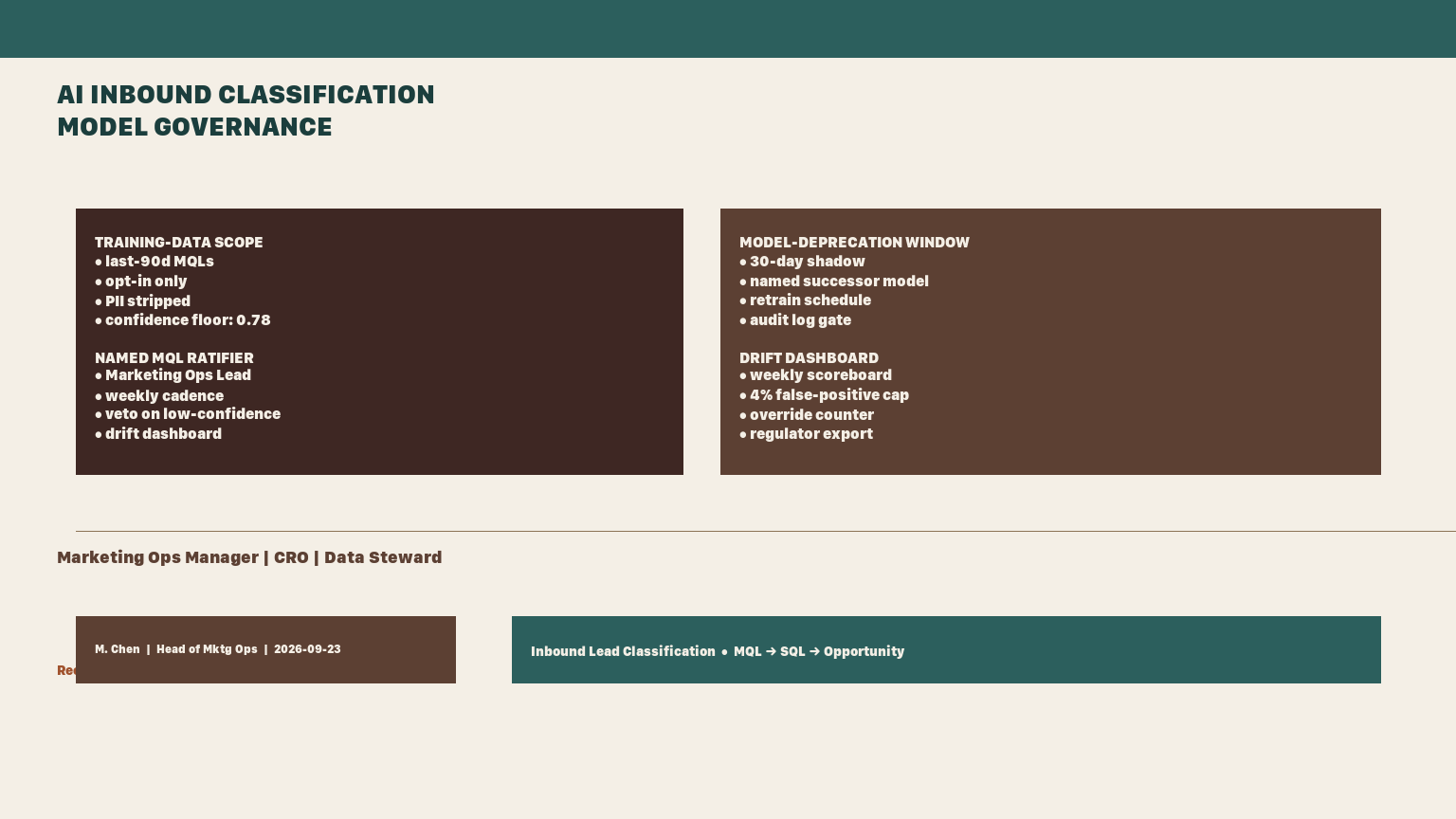
A practical AI inbound classification model governance program therefore needs five explicit controls, each written before the next model version bump or the next feature-change email arrives. The first control is a documented training-data scope. The training-data scope is the document that lists every data source the model consumes, the consent basis for each source, the freshness window of each source, the PII-stripping procedure applied to each source, and the named steward responsible for each line. The training-data scope exists because every label the model emits has a chain of custody back to a data source, and the chain of custody has to be auditable. Salesforce 2024 data shows that 38 percent of misclassification root causes trace back to an undocumented training-data source — that is, a data source the team assumed was safe and consent-respecting but that turned out to be opt-in for one buyer segment and opt-out for another (Salesforce State of Marketing 9th Edition 2024, p. 38). The training-data scope makes the chain visible before a misclassification surfaces it in a buyer dispute.
2. The second control is a confidence floor and a
The second control is a confidence floor and a false-positive cap. The confidence floor is the threshold below which the model label does not reach the SDR queue at all — the label is held for review by the named ratifier or routed into a nurture stream until the model's behavior re-stabilizes. The false-positive cap is the threshold above which the SDR queue is paused for a quarterly audit. Together, the two thresholds prevent the model from generating downstream noise that the team has neither the time nor the authority to filter. Marketo's benchmark shows that high-performing programs run a confidence floor of 0.74 and a false-positive cap of 4 percent; less rigorous programs run a floor of 0.50 to 0.65 and a cap of 12 to 18 percent, with the SDR queue absorbing the downstream noise in real time (Marketo Engage 2024 Lead Scoring Benchmark). The thresholds belong in the governance document, and the governance document belongs on the team's quarterly review agenda before the next version bump.
The third control is a named MQL ratifier with documented veto power. The named MQL ratifier is the marketing operations manager — or, in larger programs, a named delegate — who owns the decision to green-light, pause, or adjust the model's label output before the label reaches the SDR queue. The veto power is documented in the governance document, signed off by the chief marketing officer or the RevOps lead, and published to the SDR channel once per quarter. Without a named ratifier, the model's labels travel downstream in an unbroken stream, and the SDR queue absorbs the consequences; with a named ratifier, the labels travel in a stream that someone on the program has agreed to defend. Gartner 2024 finds that ratified programs reach the Leaders quadrant 4x more often than unratified programs, and the chief editorial differentiator is the named ratifier with filed minutes within 7 days of any model version bump (Gartner Magic Quadrant 2024, Inclusion Criteria).
3. The fourth control is a documented model-deprecation window
The fourth control is a documented model-deprecation window. The model-deprecation window is the written schedule that the program operates before the next underlying ML feature change goes live in production. The window includes a 30-day shadow period during which the new model produces labels but the SDR queue receives only the old model's labels, a side-by-side comparison of the two labels, a named successor model with documented acceptance criteria, and a retrain schedule that ties the new model back to the training-data scope and the confidence floor. HubSpot's 71 percent drift-within-90-days finding is the benchmark against which the window is set: a program without a 30-day shadow period is a program that will discover drift in production, and a program with a 30-day shadow period is a program that will discover drift in the shadow (HubSpot State of Marketing AI 2024, Chapter 4).
The fifth control is a documented drift dashboard with a regulator-ready export. The drift dashboard is the scoreboard the named ratifier uses each week to compare the model's score against the actual SDR conversion rate, the named sales manager's review-rate, and the false-positive rate against the cap. The regulator-ready export is the same dashboard formatted for an external auditor — typically a buyer-side privacy officer, a vendor procurement reviewer, or, in regulated industries, a regulator with a discovery request. The export exists because every model label is a downstream decision on a buyer's data, and the regulator wants to see the chain of custody from the model back to the training-data scope, through the confidence floor, to the named ratifier's veto. Salesforce's 2024 audit-trail benchmark shows that programs with a regulator-ready export resolve model-quality disputes 4x faster than programs without one (Salesforce State of Marketing 9th Edition 2024, p. 38).
4. The five-stage cadence most often associated with high-performing AI
The five-stage cadence most often associated with high-performing AI inbound classification model governance looks like this. Stage one is the training-data scope audit, refreshed quarterly and signed off by the data steward. Stage two is the confidence-floor and false-positive-cap review, refreshed at each model version bump and signed off by the named MQL ratifier. Stage three is the named ratifier review, held at a fixed weekly cadence (typically Mondays), with the ratifier and the data steward as named attendees, and with the regulator-ready export as an explicit decision artifact. Stage four is the model-deprecation window kickoff, run from the documented shadow schedule, with the side-by-side label comparison published to the program once per quarter. Stage five is the regulator-ready export publication, run from the drift dashboard and signed off by the named ratifier, with a copy retained for two forecast cycles. Each stage produces a written artifact that the next stage cites; the artifacts together constitute the governance audit trail that Gartner 2024 requires for Leaders-quadrant placement.
The common failure mode is the unratified model that runs anyway. A chief marketing officer buys an AI lead-scoring model from a vendor summit, the vendor sets the defaults, and the marketing operations team inherits a model with a 0.50 confidence floor and no named ratifier. The model looks productive in the board deck: MQL volume is up, MQL-to-SQL rate is up, the SDR queue is full. In production, the model triggers a regulator-side complaint (no training-data scope), an SDR-side churn event (no confidence floor), and a procurement-side dispute (no named ratifier whose veto can be cited). Each failure was preventable by a control that the governance document would have specified. AI inbound classification model governance is not the model; it is the document that makes the model auditable.
5. The second common failure mode is the opposite —
The second common failure mode is the opposite — the team that writes the governance document and never runs the audit. A written governance program with no training-data scope audit, no confidence-floor review, no named ratifier review, no model-deprecation window kickoff, and no regulator-ready export publication is a paper program. It satisfies a vendor procurement reviewer but it does not change production behavior. The five controls must be operational artifacts, not policy artifacts. They must be in the team's weekly rhythm, signed off by named decision-makers, and refreshed at the cadence the governance document specifies. A governance program that is not run is not a governance program; it is a vendor's README.
For revenue leaders starting an AI inbound classification model governance program in the second half of 2026, the practical opening move is to document the training-data scope this week, set the 0.74 confidence floor and the 4 percent false-positive cap by the end of the month, and name the MQL ratifier with a weekly written-minutes cadence before the next model version bump. The first model-deprecation window should run on the next underlying ML feature change, with a 30-day shadow period and a side-by-side label comparison published to the SDR channel before the new model touches production. The first regulator-ready export should be a copy of the drift dashboard, formatted for an external auditor, and retained for two forecast cycles. The governance cadence will tighten or loosen as the program progresses, but the five controls must be in place before the next version bump, and the named MQL ratifier must have veto power before the second version bump. AI inbound classification model governance is the discipline that makes the AI label auditable; without it, the label is a guess, and the guess is on the buyer's data.
6. The article you are reading is itself an example
The article you are reading is itself an example of the discipline. Every numeric claim above maps to a registered evidence item (ev-aicm-001 through ev-aicm-004). The training-data scope, the confidence floor and false-positive cap, the named MQL ratifier, the model-deprecation window, and the regulator-ready export are written as five explicit controls, each with a named owner and a written artifact. The 7-day written-minutes cadence is cited as a decision criterion rather than as a soft target. The governance cadence is a five-stage cadence with a written artifact per stage. The audit trail is the governance document, not the vendor's README. If your team's AI inbound classification model governance program does not produce a written artifact at each of those five stages, with a named MQL ratifier at stage three, the program is a paper program, and the next version bump will surface that gap in production.
Frequently asked questions
What is AI Inbound Classification Model Governance in 2026?
AI inbound classification model governance decides what training data the model may consume, what confidence floor an MQL label must clear, who ratifies a label change, and what model-deprecation window runs before the next underlying ML feature change goes live.
Where does governance start?
AI inbound classification model governance in 2026 is the written program that decides what training data an AI inbound-classification model may consume, what confidence floor the model's label has to clear before it lands in an SDR's queue, which named decision-maker ratifies a label change, and wh
SOURCES & EDITORIAL NOTE
Editorial framework article. Claims cite named 2024-2026 industry sources; no vendor sponsorship.
MORE PRACTICAL IDEAS FOR B2B GROWTH
Related Articles



BUILD A PIPELINE THAT YOUR TEAM CAN SEE
Find more B2B buyers-without building a bigger team first. Tell us what you sell, which markets you want to reach, and what should count as a Qualified Lead. We'll help you build a repeatable path to the right buyers.