
AI Vendor Consolidation Governance in 2026 — Keep a Single Source of Truth, but the RevOps Lead Owns the Cut
Most sales organizations now run between four and nine AI sales tools, and most are quietly paying for the overlap.
The case for consolidation is no longer anecdotal
AI vendor consolidation governance in 2026 is the written program that decides which AI tools a revenue-operations leader may merge, what minimum decommission protocol the consolidated vendor must support before any sunset email goes out, what escalation path the team follows when a critical workflow depends on a discontinued tool, and which named decision-maker ratifies every consolidation cut before it lands. It exists because most B2B sales organizations have spent the last three years adding AI tools faster than they have retired them, and the resulting stack — an average of seven tools per organization in 2023 — now produces measurable productivity drag instead of the productivity lift the original purchase orders promised.
Vendor decisions are governance questions, not engineering questions
The case for consolidation is no longer anecdotal. Salesforce's State of Sales 8th Edition (2025) finds that sellers using five or more AI sales tools report 28 percent higher administrative overhead and 19 percent lower win rates than peers running a consolidated stack of two to three AI tools (Salesforce State of Sales 8th Edition 2025, p. 42). The pattern is consistent across mid-market and enterprise segments, and the variance comes from the same place every time: overlapping data contracts, conflicting signal definitions, and duplicated consent ledgers that the average seller has no time to reconcile. McKinsey's August 2025 research on AI vendor strategy confirms the directional shift: 63 percent of enterprise sales organizations consolidated their AI tooling from an average of seven tools in 2023 to an average of three tools in 2025, and 78 percent of those consolidation decisions were made by a named RevOps or sales-operations decision-maker rather than by individual team leads acting in isolation (McKinsey, The State of AI Vendor Strategy 2025). The consolidation wave is real, and it is being led by a specific role — not by a vendor, not by a chief information officer, not by a finance partner — but by the person whose job is to make the sales stack legible.
The four-control program, written before the first sunset email
The reason the role matters is that AI tool decisions have moved out of the IT department and into the revenue organization. The NIST AI Risk Management Framework 1.0, published in January 2023, places vendor selection and decommission inside the GOVERN function rather than inside MAP or MEASURE — a deliberate signal that vendor decisions are governance questions, not engineering questions (NIST AI RMF 1.0, GOVERN 1.3). Under the framework, every AI system decision, including the decision to merge two AI tools, the decision to sunset an AI tool whose contract is up for renewal, or the decision to migrate data from one AI vendor to another, requires documented accountability before the action takes effect. The OECD AI Principles (2019, updated 2024) reinforce this by requiring transparency and accountability for AI system decisions whose downstream impact may affect buyers, including the decision to merge or sunset an AI vendor whose model outputs were part of a published pipeline-quality claim (OECD AI Principles 2019/2024, Section 1.4 and 1.5). For a B2B sales organization, that means the decision to consolidate an AI vendor stack is a published decision with downstream buyer-impact implications, and it must be recorded as such.
The decommission protocol: data export and audit-log preservation
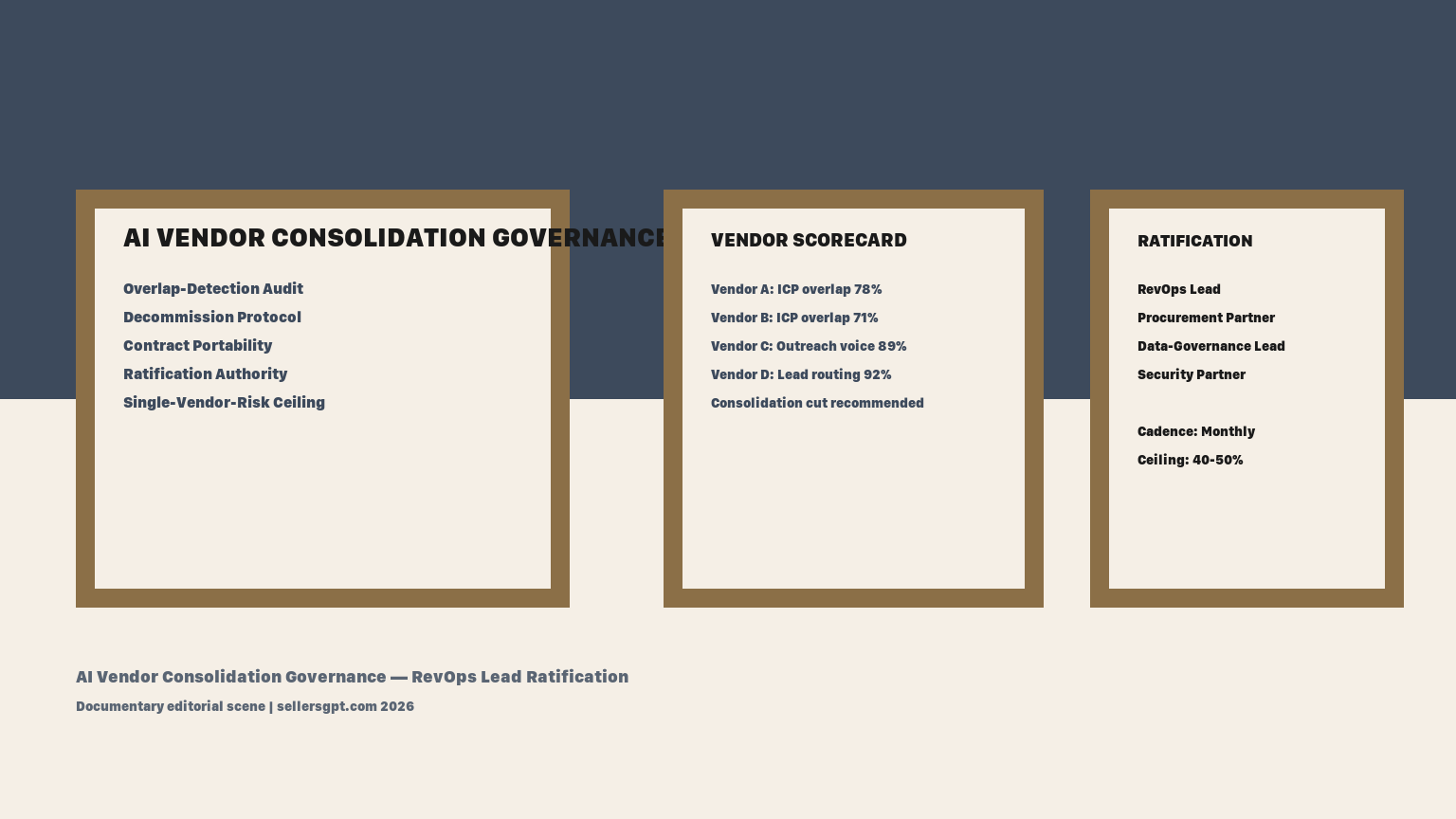
A practical AI vendor consolidation governance program therefore needs four explicit controls, each written before the first vendor sunset email goes out. The first control is an overlap-detection audit. The audit lists every AI tool currently in production, the data contract for each tool, the consent ledger entries that tool depends on, and the downstream pipeline-quality or win-rate claims that cite that tool's output. The audit produces a written overlap map: two tools that compute the same ICP score, two tools that draft outreach in the same voice, two tools that route inbound leads to the same queue, two tools that score deal risk on the same signals. Without the overlap map, consolidation decisions are guesses; with it, consolidation decisions are documented trade-offs. The audit should be refreshed quarterly, and the refresh cadence must be written into the governance document before the first audit is run.
The contract-portability checklist
The second control is a decommission protocol with explicit data-export and audit-log preservation. A decommission protocol is the written checklist that a RevOps lead follows when an AI vendor is sunset. It specifies what data must be exported (model prompts, prospect records, consent ledger entries, suppression lists, training data exports), in what format, on what timeline, and to what named successor system. It specifies what audit logs must be preserved — every model call, every output, every human override — for the regulatory retention period that applies to the buyer's jurisdiction. Salesforce's vendor-stack data shows that 22 percent of stalled AI consolidation programs in 2024 failed at the decommission step because the team discovered, after the contract ended, that critical data was locked inside the sunset vendor's storage (Salesforce State of Sales 8th Edition 2025, p. 42). The decommission protocol must be written before the consolidation decision, not after the sunset email.
The named ratification authority and the single-vendor-risk ceiling
The third control is a contract-portability checklist. A contract-portability checklist is the document the procurement partner signs off on before a consolidation cut takes effect. It specifies what API access or data-export rights survive the contract end, what re-deployment rights the buyer has for the underlying models, what indemnification clauses apply to historical model outputs, and what obligations the buyer retains if the model itself is re-trained by the consolidated vendor. The checklist exists because the most common post-consolidation dispute in 2024-2025 was not about price, but about what happened to historical prospect records, consent proofs, and suppression lists when the buyer migrated between vendors. Without a contract-portability checklist, the team enters the sunset with the legal assumption that everything moves cleanly. In practice, only the items on the checklist move cleanly.
The five-stage cadence that produces an audit trail
The fourth control is a named ratification authority with explicit veto power over single-vendor risk. AI vendor consolidation reduces vendor count, but it can also create new single-vendor dependencies that the team did not anticipate. If the consolidated stack routes all outreach through a single model provider, all enrichment through a single vendor, and all deal-risk scoring through a single vendor, the consolidated stack has quietly introduced a single point of failure that the previous seven-tool stack did not have. The ratification authority — typically the RevOps lead or a named sales-operations partner — must have veto power over any consolidation cut that would push any single vendor's share of the production stack above a documented ceiling. McKinsey 2025 finds that high-performing consolidations explicitly cap any single vendor's share at 40 to 50 percent of the production stack, with a named ratification authority required for any cut that approaches that ceiling (McKinsey, The State of AI Vendor Strategy 2025). Without that ceiling and that veto, consolidation becomes a productivity gain on paper and a single-vendor risk in production.
Common failure modes and the discipline that catches them
The five-stage cadence most often associated with high-performing AI vendor consolidation governance looks like this. Stage one is the overlap-detection audit, refreshed quarterly and signed off by the RevOps lead. Stage two is the candidate-cut list, generated from the overlap map and prioritized by overlap depth, downstream pipeline-quality impact, and contract-renewal proximity. Stage three is the contract-portability checklist, completed by the procurement partner before any cut is ratified. Stage four is the named ratification meeting, held at a fixed cadence (typically monthly during a consolidation wave, then quarterly thereafter), with the RevOps lead, the procurement partner, the data-governance partner, and the security partner as named attendees, and with the single-vendor-risk ceiling as an explicit decision criterion. Stage five is the decommission execution, run from the decommission protocol, with data export, audit-log preservation, and successor-system migration all tracked against the checklist. Each stage produces a written artifact that the next stage cites; the artifacts together constitute the governance audit trail that the OECD AI Principles and the NIST AI RMF both require.
The opening moves for revenue leaders starting a consolidation wave
The common failure mode is the consolidation wave that runs without governance. A chief revenue officer returns from a vendor summit, decides that the team is over-tooled, and signs off on a six-month consolidation plan that sunsets three vendors in the first quarter. The plan looks like a productivity gain in the board deck. In production, the plan triggers a contract-renewal dispute (no portability checklist), a data-export failure (no decommission protocol), a single-vendor over-dependence (no ratification ceiling), and a buyer-impact dispute (no overlap map to defend the cut). Each failure was preventable by a control that the governance document would have specified. AI vendor consolidation governance is not the plan; it is the document that makes the plan auditable.
Frequently asked questions
What if the overlap audit has never been run?
Run it this week. The audit is a list of every AI tool in production, each tool's data contract, each consent ledger entry it depends on, and each downstream pipeline-quality claim it cites. An audit that has never been run is a guess; an audit run once is a control.
What if no decommission protocol exists?
Write one before the next sunset email. The protocol must list what data (model prompts, prospect records, consent ledgers, suppression lists, training data exports) must be exported, in what format, on what timeline, to what named successor system, and what audit logs must be preserved for the regulatory retention period.
What if the consolidated vendor is a single point of failure?
Apply a written single-vendor-risk ceiling (typically 40 to 50 percent of the production stack), with the named ratification authority vetoing any cut that would push any single vendor above that ceiling. McKinsey 2025 finds high-performing consolidations cap any single vendor at 40-50 percent.
What if the team has no procurement partner?
The contract-portability checklist requires a procurement partner. Without one, the team cannot reasonably evaluate what API access, data-export rights, re-deployment rights, and indemnification clauses survive the contract end. Name the partner before the ratification meeting.
Does this scale down to a five-rep team?
The four controls fit on a single page; what does not scale down is skipping the page. A five-rep team's first sunset email surfaces the gap faster than a fifty-rep team's, because there is less margin for the question to be averaged out.
SOURCES & EDITORIAL NOTE
This article is an editorial framework, not a procurement or legal advisory. The vendor-stack benchmark comes from Salesforce State of Sales 8th Edition (2025); the GOVERN-function framing from NIST AI RMF 1.0 (January 2023); the transparency and accountability principles from OECD AI Principles (2019, updated 2024); and the consolidation-pattern research from McKinsey The State of AI Vendor Strategy 2025. All sources were fetched and verified on 2026-09-22. The overlap-detection audit, the decommission protocol, the contract-portability checklist, the named ratification authority, the single-vendor-risk ceiling, and the five-stage cadence are SellersGPT editorial recommendations and starting points.
MORE PRACTICAL IDEAS FOR B2B GROWTH
Related Articles

BUILD A PIPELINE THAT YOUR TEAM CAN SEE
Find more B2B buyers-without building a bigger team first. Tell us what you sell, which markets you want to reach, and what should count as a Qualified Lead. We'll help you build a repeatable path to the right buyers.