
AI Prospecting in 2026 — Rotate Sources Before You Rotate Reps
When AI prospecting underperforms, leaders often change the copy, the model, or the rep. The more durable diagnosis begins one step earlier: which source was allowed to put this account into the queue, how fresh was its evidence, and was that evidence suitable for the channel and action that followed? Source rotation turns those questions into an operating system rather than a postmortem.

Start with a source contract, not a vendor ranking
A source contract is a short operational record for every input that can influence account selection or outreach. It should state what the source is for, which entity it describes, how identity is resolved, how quickly it becomes stale, which actions it may support, and who reviews exceptions. This is more useful than a generic quality score because quality depends on purpose. A quarterly industry directory might be credible for defining a market and still be too old to justify a message about a current role.
The contract should separate observation from inference. A corporate page naming a new facility is an observation tied to a URL and retrieval time. The statement that the facility creates an urgent need for your product is a hypothesis. An intent provider's score is another provider's derived signal, not a direct account commitment. Keeping those types distinct prevents a scoring model from turning stacked inferences into apparent facts. NIST's Generative AI Profile highlights context, confabulation, privacy, and monitoring risks; source-level lineage is one concrete control for those risks.
Give each source a stable identifier and preserve it through enrichment, scoring, drafting, and review. If a seller challenges a message, the team should be able to trace the account's entry into the queue without reconstructing the decision from screenshots. Record the source version or retrieval time, the original entity key, transformations, and the rule that permitted the next step. The record does not need to be elaborate, but it must survive downstream summarization.
Resolve identity before scoring intent
Source rotation fails when the system treats every row as a new prospect. One company may appear under a legal name, a trading name, a regional domain, and several subsidiaries. One person may appear with a personal address, an old employer address, and a social profile. If identity resolution happens after prioritization, the queue can assign duplicate work, send conflicting messages, or misread repeated records as independent demand signals.
Create canonical account and contact identities before a record is eligible for outreach. Preserve the aliases rather than deleting them, because aliases explain how the match was made and help detect future duplicates. Match conservatively across domain, legal entity, location, role history, and source-specific identifiers. When the match is uncertain, hold the record for review instead of forcing a merge. A false merge can contaminate every later fact; a missed merge can create duplicate contact. Both are operational risks, not merely database hygiene.
Deduplication also needs a time dimension. A repeated event from the same source may be a refresh, not a new signal. Two providers may syndicate the same underlying event. Define a signal fingerprint using the account, event type, observed date, and originating evidence. Then decide whether corroboration raises confidence or merely repeats the same upstream source. The queue should count independent evidence, not the number of vendors that resold it.
Make freshness specific to the decision
There is no universal expiration date for prospecting data. A headquarters address may remain useful for years. A job title can become unreliable in months. A product-page visit may matter for days, while a regulatory filing may frame an account for a quarter. Assign freshness windows by field and intended action, not by entire record. A record can remain valid for segmentation while becoming ineligible for personalized outreach.
Use three states instead of fresh versus stale. Current evidence can support its contracted action. Aging evidence can support research but requires confirmation before external use. Expired evidence cannot trigger the action and must be refreshed or removed from that route. This middle state is important because hard deletion encourages teams to retain data too long, while an immediate discard wastes potentially useful context.
Every material claim in an outbound draft should inherit the freshness state of its source. If a draft says a buyer is leading an expansion, the reviewer should see when and where that was observed. If the source is aging, the system can rewrite the message around a broader, verified company condition or abstain from personalization. The model should not conceal staleness with fluent language.
Match the source to the channel and action
A source-to-channel contract specifies what may happen next. A verified company-domain address with current role evidence may enter an email review queue. A public professional profile may support role research without authorizing an automated direct message. An event attendee list may have contractual restrictions that differ from a public directory. A website visit signal may prioritize account research while remaining too ambiguous to mention to the recipient.
Separate research permission, prioritization permission, drafting permission, and sending eligibility. These are distinct gates. An AI agent may use broad public material to understand an industry, but only approved claims should enter a message. A source can help rank accounts without granting contact rights. The queue should enforce those boundaries in code or workflow state, not rely on the model to remember policy from a prompt.
Channel fit includes technical deliverability. Google's sender guidance requires authentication and other practices for mail to Gmail accounts, with additional requirements for bulk senders, and identifies a spam-rate threshold below 0.3 percent. Yahoo similarly emphasizes relevant mail to an active audience, authentication, easy unsubscribe, and prompt honoring of unsubscribe requests. These are channel controls; a high-quality prospect source does not compensate for weak sender configuration or unwanted frequency.
Put suppression ahead of optimization
Suppression is a veto, not another feature in the score. Check opt-outs, do-not-contact flags, legal restrictions, customer status, open disputes, active opportunities, account-owner rules, and frequency limits before the record can be routed. The FTC's CAN-SPAM guide makes clear that U.S. commercial email requirements apply to business-to-business messages and that outsourcing sending does not remove the advertiser's responsibility. The queue therefore needs one authoritative suppression decision even when research, sequencing, and delivery involve different vendors.
Resolve conflicts in favor of the stricter current restriction. If the CRM says contact is allowed while a recent unsubscribe event says it is not, stop. If two business units maintain separate suppression lists, join them before allocation. Record why the account was held without exposing unnecessary personal data to every user. A good suppression system prevents action and leaves a clear audit event; it does not quietly lower a lead score and hope the record falls below a threshold.
Recheck eligibility at execution time. A message approved yesterday may become impermissible today because the recipient opted out, an opportunity opened, or account ownership changed. Approval should bind to the evidence and recipient version reviewed, but it should never override a newer suppression event.
Rotate sources using evidence, not calendar habit
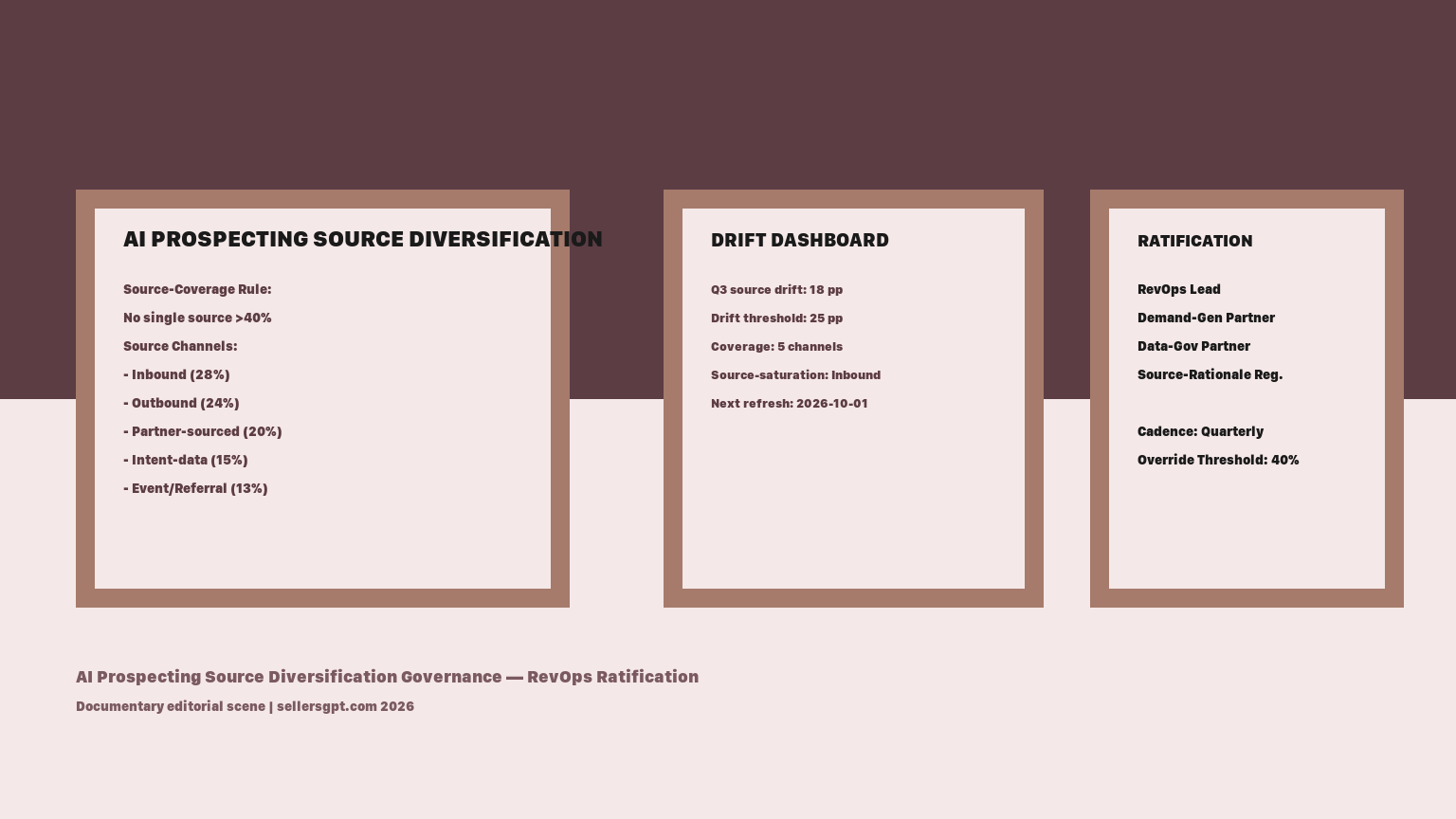
Rotation does not mean switching providers every month. It means changing the share of queue admissions when evidence quality or audience response changes. Build a scorecard with measures that can be observed before and after outreach: identity-match confidence, field freshness, independent corroboration, duplicate rate, suppression-hit rate, unavailable required fields, reviewer rejection reasons, bounce outcomes, complaint signals, and the proportion of records that need manual repair.
Compare sources within equivalent segments and actions. A source used for enterprise manufacturing accounts should not be judged against a source used for small software firms. Separate source contribution from copy and rep execution by preserving the lineage through the funnel. If one source generates many meetings but also many disqualified accounts, the answer may be tighter eligibility rather than more volume. If reviewers repeatedly remove the same inferred claim, revise the contract that allowed it.
Set caps and stop rules in advance. A new source can begin with a limited cohort and mandatory review. Expand only after identity, freshness, suppression, and channel checks behave as designed. Pause when duplicate or eligibility failures exceed the team's agreed tolerance, when the source changes its collection method without review, or when an external requirement changes. Avoid inventing universal percentages: the tolerance should reflect deal value, review capacity, buyer harm, and the reversibility of the action.
A 30-day source-rotation implementation
In the first week, inventory every source that can place an account or person into a prospecting workflow. Assign identifiers, owners, intended uses, prohibited uses, entity keys, freshness rules, and contractual constraints. Trace ten recent outbound records backward. Any step that cannot be explained becomes a remediation item before more automation is added.
In the second week, establish canonical identity and suppression services. Run sources through those controls without sending. Measure duplicate clusters, uncertain matches, stale fields, and conflicting permissions. Review samples with sales operations and legal or privacy owners where appropriate. The deliverable is an eligibility record that every downstream workflow can read.
In the third week, map sources to permitted channels and launch a small reviewed cohort. Attach source lineage and freshness to each draft. Ask reviewers to choose structured rejection reasons rather than editing silently. Monitor authentication, bounce, complaint, and unsubscribe signals at the sender level. This separates input failures from message and channel failures.
In the fourth week, hold the first rotation review. Keep, cap, pause, or requalify each source by segment and action. Document the decision and the next evidence required. The review should also identify unnecessary sources: two providers may add cost and complexity while relying on the same upstream data. Removing a redundant source can improve clarity more than adding another feed.
The operating principle
AI prospecting becomes reliable when the system can explain why this account, why now, from which evidence, through which channel, under whose permission. That explanation begins before the model writes a line of copy. Source rotation makes upstream quality visible and creates a disciplined way to respond when it changes.
Before replacing a rep or rewriting a sequence, audit the top three sources feeding the queue. For each one, write down its freshness window, identity rule, channel contract, suppression check, and rotation cap. If any field is unknown, the source is not ready to trigger autonomous action. The right response is not more confidence from the model. It is a better source contract.
Frequently asked questions
What does source rotation mean in AI prospecting?
Source rotation means changing which inputs may admit accounts into a workflow, or changing their share, when freshness, duplicate, suppression, reviewer, or channel evidence changes. It is not a requirement to replace vendors on a fixed schedule.
Should one source be used for both scoring and outreach?
Only when its contract supports both uses. A source may be suitable for market sizing or prioritization while remaining too old, ambiguous, or restricted to support a personalized message or external contact.
How should teams handle two providers reporting the same signal?
Preserve the upstream lineage and determine whether the reports are independent. If both providers syndicated the same event, count it as one observation rather than treating the duplicate as stronger demand.
When should a prospecting source be paused?
Pause it when required identity, freshness, suppression, or channel gates fail; when its collection method changes without review; or when observed errors exceed the tolerance defined for that segment and action.
SOURCES & EDITORIAL NOTE
NIST sources provide general AI risk context; FTC, Google, and Yahoo provide compliance and sender guidance. The source-contract, rotation, and queue controls are SellersGPT editorial recommendations. No campaign-performance claim is made. Sources checked September 10, 2026.
- National Institute of Standards and Technology (NIST): AI Risk Management Framework
- National Institute of Standards and Technology (NIST): Artificial Intelligence Risk Management Framework: Generative Artificial Intelligence Profile
- Federal Trade Commission: CAN-SPAM Act: A Compliance Guide for Business
- Google: Email sender guidelines
- Yahoo Sender Hub: Sender Requirements & Recommendations
MORE PRACTICAL IDEAS FOR B2B GROWTH
Related Articles

BUILD A PIPELINE THAT YOUR TEAM CAN SEE
Find more B2B buyers-without building a bigger team first. Tell us what you sell, which markets you want to reach, and what should count as a Qualified Lead. We'll help you build a repeatable path to the right buyers.