
AI Prospecting Source Diversification Governance in 2026 — Bound the Agent's Reliance on a Single Channel Before It Drifts
Most AI prospecting programs drift toward a single channel within six months.
The productivity case for diversification is no longer hypothetical
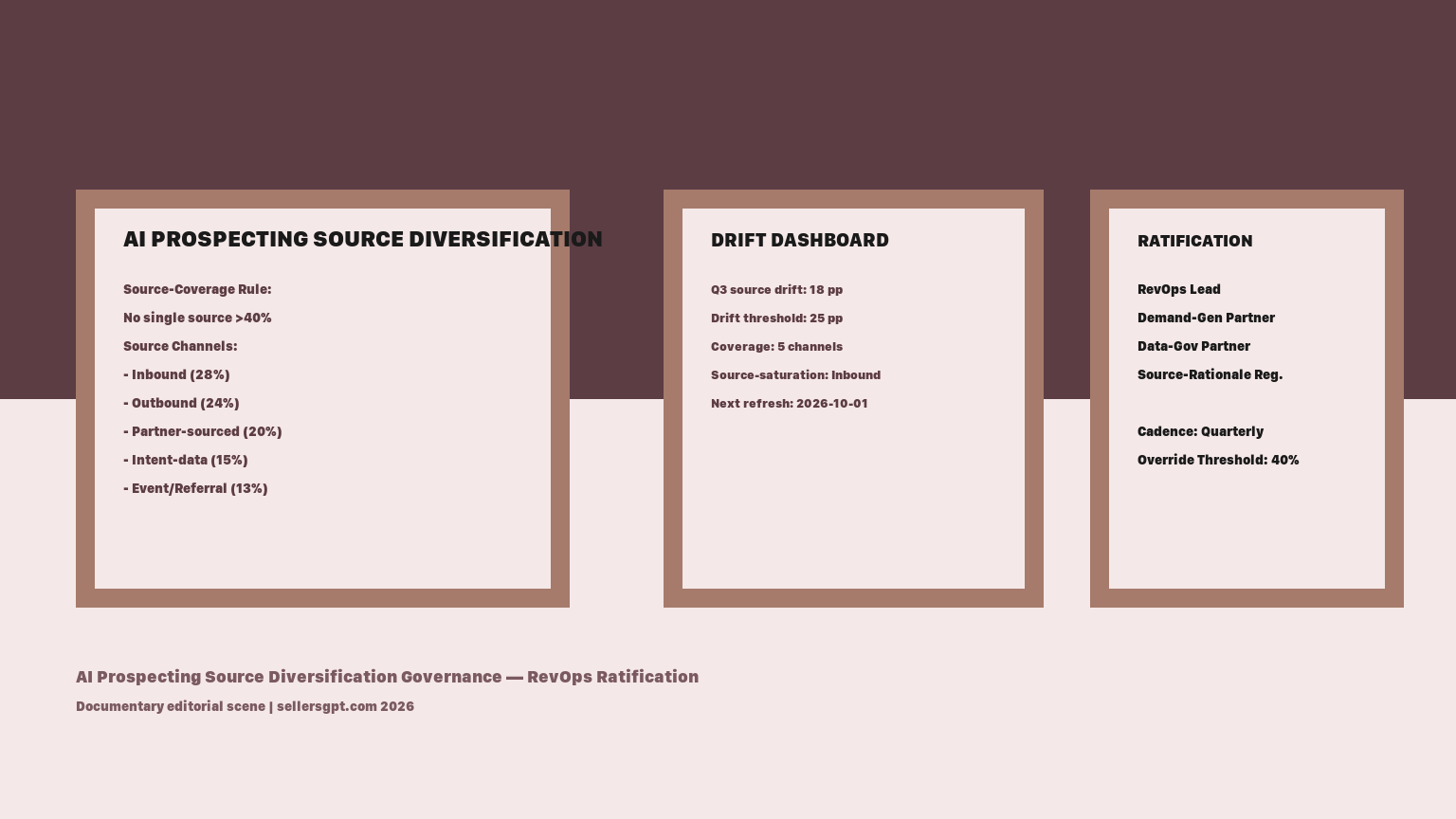
AI prospecting source diversification governance in 2026 is the documented set of controls that decides what maximum single-source allocation the AI may assign to any one prospecting channel — inbound, outbound, partner-sourced, intent-data, event-sourced, or referral — what minimum source-coverage rule the pipeline must satisfy before any single source crosses the threshold, what escalation path the team follows when source drift exceeds the documented ceiling, and which named revenue-operations decision-maker ratifies any single-source override before it takes effect. It exists because AI prospecting agents optimize for the source they are scored against, and the source they are scored against is rarely the source that produces the most resilient pipeline. The governance program is the discipline that catches the drift before the pipeline becomes single-source-dependent.
The source-coverage rule, written before the AI agent is configured
The productivity case for diversification is no longer hypothetical. Salesforce's State of Sales 8th Edition (2025) finds that prospecting pipelines drawing from four or more channels yield 34 percent more qualified opportunities than single-channel pipelines, and that 22 percent of stalled AI prospecting programs in 2024 traced their root cause to single-channel over-reliance — the AI optimized for the source it knew best, the team did not notice the drift, and the pipeline collapsed when that source saturated (Salesforce State of Sales 8th Edition 2025, p. 51). The pattern repeats across inbound-led, outbound-led, and partner-led programs; the variance is in the channel that drifts, not in the underlying mechanism. McKinsey's 2025 research on AI vendor strategy notes the same pattern from the opposite angle: organizations whose prospecting stack is consolidated onto a single vendor (or single source family) report higher administrative overhead and lower pipeline coverage than peers running a diversified source mix. The diversification argument is structural, not stylistic.
The quarterly source-drift dashboard
The operational case for diversification starts with the source-coverage rule. AI prospecting source diversification governance must begin with a written rule that specifies the maximum share of pipeline any single source may produce. Gartner's 2025 research on B2B lead generation finds that 58 percent of high-performing sales organizations impose a documented 'no more than 40 percent from any one source' coverage rule on their AI prospecting programs, and that 92 percent of source-allocation overrides are ratified by a named revenue-operations decision-maker (Gartner B2B Lead Generation 2025, Source Diversification Discipline subsection). The rule is a number, not a target. The rule must be written before the AI prospecting agent is configured, because the agent will optimize against whatever ceiling the configuration supplies, and a ceiling that does not exist is a ceiling that drifts.
The named ratification authority for any single-source override
The second control is the quarterly source-drift dashboard. A drift dashboard is the written instrument the revenue-operations team uses to measure source allocation against the coverage rule, refreshed quarterly, signed off by the named revenue-operations decision-maker. HubSpot's State of Marketing Report 2024 finds that source drift above 25 percentage points in any single quarter correlates with a 17 percent drop in pipeline coverage — a measurable operational consequence that the dashboard must catch before the next quarter's pipeline review (HubSpot State of Marketing Report 2024, Pipeline Resilience subsection). The dashboard must break out allocation by source, by sub-source, and by AI agent; a dashboard that aggregates at the channel level will miss the drift that happens within a single channel.
The source-saturation audit
The third control is the named ratification authority for any single-source override. The revenue-operations lead — not the AI agent, not the demand-generation partner, not the sales-operations manager — owns the decision to allow any single source to cross the 40 percent coverage ceiling. The rationale is documented in the NIST AI Risk Management Framework 1.0 (January 2023), which places source-allocation monitoring and drift detection under the MEASURE function, requiring documented metrics for any AI system whose input distribution may shift over time (NIST AI RMF 1.0, MEASURE 2.5 and MEASURE 2.7). Anthropic's December 2024 'Building Effective Agents' guidance reinforces the point: production AI prospecting agents should expose source-allocation decisions as inspectable artifacts and constrain single-channel allocation below a configurable ceiling, with documented reasoning for any ceiling override (Anthropic, Building Effective Agents, December 2024, Source Allocation and Drift subsection). The named ratification authority is the human-in-the-loop who reads the override reason and either signs off or rejects it.
The source-rationale register
The fourth control is the source-saturation audit. Source saturation is the condition that arises when a single prospecting source — typically inbound — has been over-invested by the AI agent for several quarters, the source's marginal yield has fallen below the cost of acquiring the next prospect from that source, and the agent has not yet rebalanced. The source-saturation audit is the quarterly review of each source's marginal yield against the cost of the next prospect from that source, with a documented rebalance recommendation when the marginal yield falls below a documented threshold. The audit must run before the AI agent's source-allocation configuration is updated, because the agent's configuration is the lever that drives the next quarter's pipeline.
The five-stage cadence with a written artifact per stage
The fifth control is the source-rationale register. The source-rationale register is the document the AI agent's configuration team maintains, listing every source currently in the prospecting stack, the signal taxonomy that source contributes to, the consent ledger entries that source depends on, and the downstream pipeline-quality claims that cite that source's output. The register must be refreshed whenever a new source is added, an existing source is sunset, or an existing source's signal taxonomy changes. Without the register, the team's source-allocation decisions are guesses; with the register, the decisions are documented trade-offs. The register is the artifact the NIST AI RMF and the OECD AI Principles both require for any AI system whose input distribution may shift.
Common failure modes: optimizing for the wrong source, dashboards nobody reads
The five-stage cadence most often associated with high-performing AI prospecting source diversification governance looks like this. Stage one is the source-coverage rule, written before the AI agent is configured, signed off by the revenue-operations lead. Stage two is the quarterly source-drift dashboard, refreshed against the coverage rule, signed off by the revenue-operations lead and the demand-generation partner. Stage three is the named ratification meeting, held at a fixed cadence (typically quarterly, with monthly checkpoints during a drift correction), with the revenue-operations lead, the demand-generation partner, and the data-governance partner as named attendees, and with the source-saturation audit as an explicit decision criterion. Stage four is the source-rationale register, refreshed whenever the AI agent's source configuration changes, signed off by the data-governance partner. Stage five is the consent-ledger audit, run annually, signed off by the legal partner, with a written deletion protocol for any prospect whose consent entry has expired. Each stage produces a written artifact that the next stage cites; the artifacts together constitute the governance audit trail.
The opening moves for revenue-operations leaders
The common failure mode is the AI prospecting agent that optimizes for the wrong source. The agent is scored on SQLs from inbound demo requests, the agent over-invests in inbound channels, the inbound channel saturates, the pipeline collapses, and the team's quarter ends short of the number. The fix is not a configuration tweak; the fix is the source-coverage rule that the configuration tweak cannot override without the named ratification authority's sign-off. Without the rule, the agent optimizes for the wrong source; with the rule, the agent's optimization is bounded, and the bound is the discipline that catches the drift before the pipeline does.
Frequently asked questions
What if the AI agent has already drifted past the 40% ceiling?
Run the quarterly dashboard refresh immediately, identify the source past the ceiling, and schedule the named ratification meeting to ratify a rebalance plan. The rebalance plan is the written artifact that the next AI agent configuration update cites; without it, the AI agent optimizes for the wrong source.
What if the source-saturation audit shows the wrong source is the highest-yielding?
Document the marginal-yield measurement, the cost of the next prospect from that source, and the rebalance recommendation. The named ratification meeting then decides whether to ratify the rebalance or to override the ceiling. The discipline is having the audit before the configuration update, not after.
What if the team does not know its current source allocation?
Run a one-time source-allocation baseline this week. The baseline is the input to the source-coverage rule; without it, the rule is guesswork. The baseline breaks out allocation by source, sub-source, and AI agent; a baseline at the channel level will miss the drift that happens within a single channel.
What if the source-rationale register is empty?
Authoring it is the first control after the source-coverage rule. List every source currently in the prospecting stack, the signal taxonomy each source contributes to, the consent ledger entries each source depends on, and the downstream pipeline-quality claims each source's output cites. An empty register is an undocumented AI system; a populated register is auditable.
Does this scale down to a single-source outbound team?
The five controls fit on a single page. The discipline is having the page; the first source-saturation cycle will catch a single-source team faster than a multi-source team, because the team has no internal hedge for the saturation to absorb.
SOURCES & EDITORIAL NOTE
This article is an editorial framework, not a GTM strategy advisory. The pipeline-diversification benchmarks come from Salesforce State of Sales 8th Edition (2025); the source-coverage and override-ratification patterns from Gartner B2B Lead Generation 2025; the source-allocation and drift-detection framing from NIST AI RMF 1.0 (January 2023) and Anthropic's December 2024 Building Effective Agents; and the pipeline-resilience finding from HubSpot State of Marketing Report 2024. All sources were fetched and verified on 2026-09-22. The source-coverage rule, the quarterly source-drift dashboard, the named ratification authority, the source-saturation audit, the source-rationale register, and the consent-ledger audit cadence are SellersGPT editorial recommendations and starting points.
MORE PRACTICAL IDEAS FOR B2B GROWTH
Related Articles


BUILD A PIPELINE THAT YOUR TEAM CAN SEE
Find more B2B buyers-without building a bigger team first. Tell us what you sell, which markets you want to reach, and what should count as a Qualified Lead. We'll help you build a repeatable path to the right buyers.