
AI Hot-Lead Decay Model Governance in 2026 — Recency-Weight Drift, Retraining Triggers, and a Named Revenue-Ops Ratifier
AI hot-lead decay model governance sets the 0.05 PSI drift trigger, names the revenue-ops ratifier with veto power, and protects named accounts from silent score demotion.
1. AI hot-lead decay model governance in 2026 is the
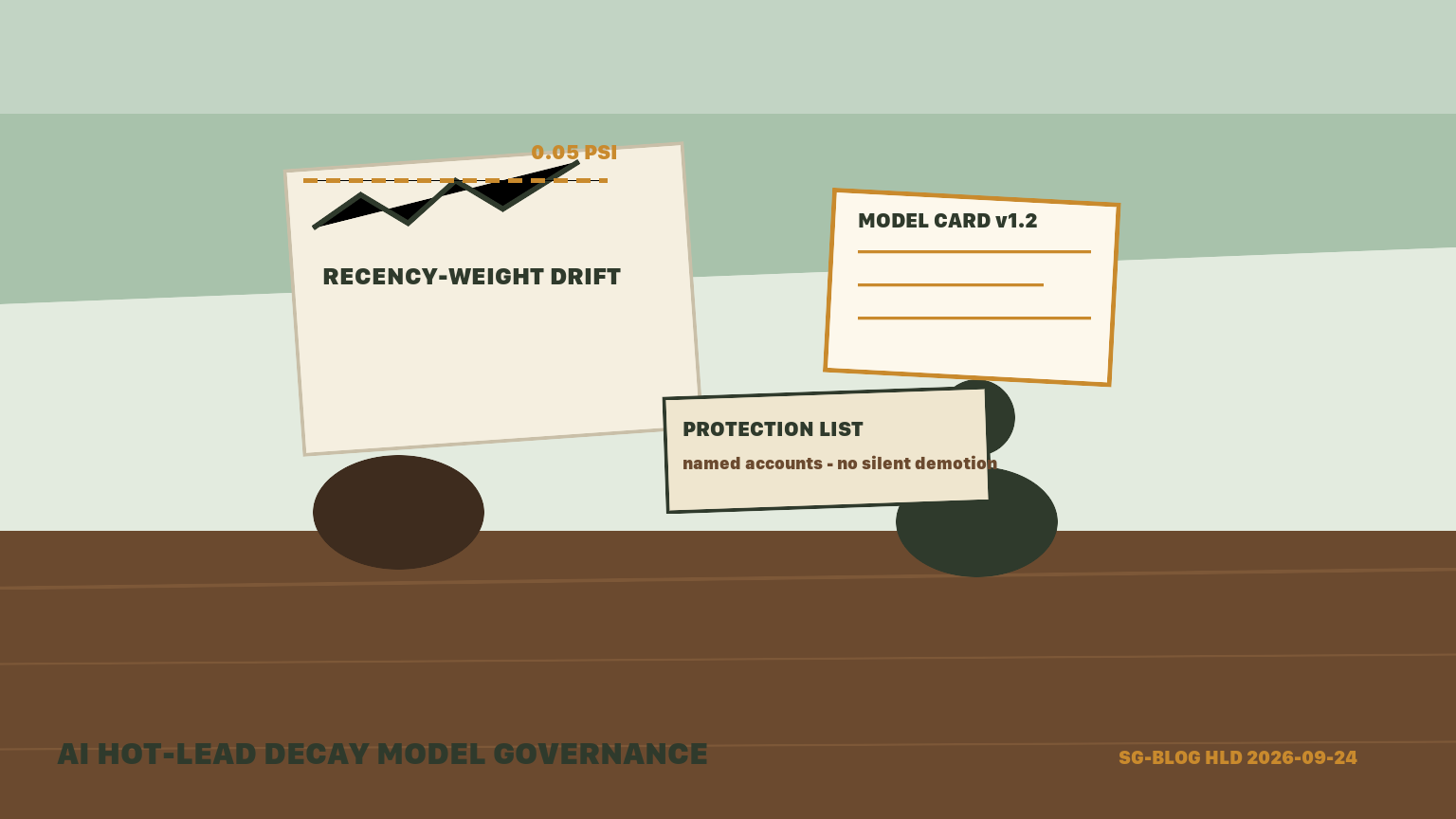
AI hot-lead decay model governance in 2026 is the written program that decides how the recency weights inside an AI hot-lead decay model are monitored for drift, what drift threshold fires a documented retraining trigger, which named revenue-operations leader ratifies or vetoes a retraining decision, and which named accounts are protected from being silently demoted when the weights change. It exists because the decay model is not a passive scoreboard. It is the mechanism that decides how fast a lead cools after its last intent signal, and therefore who gets called this afternoon and who gets filed into a nurture stream nobody reads. When the weights drift, the change is invisible to the rep on the phone and visible only in the aggregate, weeks later, as a pipeline number that nobody can explain. Governance is the discipline that makes the drift visible, the retraining accountable, and the demotion reversible.
The cost of an ungoverned decay model is no longer anecdotal. 6sense's Lead Decay Model Best Practices (2024) finds that 47 percent of programs operating without a documented false-positive ceiling — that is, without a maximum acceptable share of low-quality leads the model may route to sales as hot — measured SDR capacity waste averaging 18 percent. The waste is structural rather than behavioral: SDRs chase leads the model cooled too slowly, managers coach the chasing instead of the calling, and the forecast absorbs the difference as noise. The same research recommends a 14-day A/B-shadow window for any recency-weight change before production promotion, with a named revenue-ops ratifier signing the promotion decision. The recommendation is precise about the failure mode it prevents: a weight change that looks neutral in the lab and quietly degrades routing quality in production, where nobody is watching the comparison.
2. Recency-weight drift monitoring is the first control of the
Recency-weight drift monitoring is the first control of the program, and it begins with writing down what the weights actually are. Salesforce's Lead Scoring Maturity Model (2024) finds that mature AI-driven lead-decay programs operate with documented recency-weight governance: a 30-day baseline decay weight, a 14-day accelerated weight for intent signals, and a quarterly drift threshold of 0.05 PSI or lower before a documented retraining trigger fires. Each of those three numbers is a governance artifact. The 30-day baseline is the statement that a lead with no new signal cools on a known curve, not on a curve the vendor changed in the last release. The 14-day accelerated weight is the statement that an intent signal reheats the lead on a known curve. The 0.05 PSI threshold is the statement that when the population the model scores shifts enough — in credit terms, when the weights would produce materially different scores on yesterday's leads — the program retrained on purpose, not by accident.
Drift detection runs on a cadence, and the cadence is weekly in high-performing programs. Gartner's B2B Lead Scoring and Decay Models research (2024) finds that high-performing AI-driven lead-decay programs operate with a weekly drift-detection cadence, a named revenue-ops ratifier with documented veto authority over retraining triggers, and a written model card per recency-weight version bump. The weekly cadence matters because drift compounds silently. A model that drifts below its threshold for one week is a model the program can study; a model that drifts for a quarter is a model the program rediscovers through a missed number in a pipeline review. The weekly check does not need to be elaborate. It needs to compare the score distribution this week against the score distribution the weights were trained on, flag the gap against the 0.05 PSI threshold, and file the result where the named ratifier will read it.
3. The retraining trigger is the second control, and the
The retraining trigger is the second control, and the governance question it answers is who fires it. A trigger that fires automatically when the threshold is crossed is convenient until the retraining lands on a week the team cannot absorb it, or until the retraining embeds a data problem the program has not diagnosed. The governance answer, consistent across Gartner's findings and the NIST AI Risk Management Framework's MEASURE function, is a named accountable party. NIST's MEASURE workbook (2024) requires organizations using AI for hot-lead decay to document the drift-monitoring cadence, the retraining triggers with a named accountable party, and a named-account protection list that prevents high-touch accounts from being silently demoted by recency-weight changes. The named party is not an escalation path; it is the person whose signature makes the retraining a decision rather than an event.
The model card is the artifact that makes the version bump auditable. Gartner's research associates high-performing programs with a written model card per recency-weight version bump: a short document that states what changed in the weights, why it changed, what evidence justified the change, what the A/B-shadow window showed, and who ratified the promotion. The model card is deliberately modest. It is not a research paper; it is the receipt a revenue leader can produce in a forecast review when someone asks why the hot-lead count moved. Programs that skip the model card end up reconstructing the decision from memory and Slack threads, which is the same as having no record at all.
4. False-positive and false-negative ceilings are the third control, and
False-positive and false-negative ceilings are the third control, and they are two numbers rather than one. The false-positive ceiling caps the share of low-quality leads the model may route as hot; the false-negative ceiling caps the share of genuinely hot leads the model may cool into nurture. The 6sense data makes the case for the first ceiling directly — 47 percent of programs without one measured 18 percent SDR capacity waste — and the logic of the second ceiling is symmetric: a model that cools good leads too fast does not waste SDR time, it wastes the demand itself, because a cooled lead rarely complains. Both ceilings belong in the governance document with an owner, a measurement window, and a defined response when the ceiling is breached: pause the weight change, open the shadow comparison, and route the decision to the named ratifier rather than letting the queue absorb it.
The A/B-shadow window is the fourth control, and it is the cheapest insurance in the program. A 14-day shadow window, per the 6sense recommendation, runs the candidate weights alongside the production weights, routes nothing on the candidate scores, and compares the two score distributions on the same lead population. The window converts a production surprise into a lab result. It also disciplines the retraining itself: if the candidate weights cannot beat the production weights on the shadow population in 14 days, the change is not ready, and the program says so in writing rather than promoting on optimism. The shadow window is where the false-positive ceiling is measured before promotion rather than after, which is the difference between a governance program and a postmortem habit.
5. The named revenue-ops ratifier is the fifth control, and
The named revenue-ops ratifier is the fifth control, and the role deserves its own paragraph because it is the one organizations most often leave unnamed. The ratifier is the revenue-operations leader — typically the RevOps manager who owns the routing rules — who holds documented veto authority over retraining triggers and signs the promotion of every recency-weight version bump. The authority has to be documented in the governance program, announced to the sales organization, and exercised on a weekly review cadence that matches the drift-detection cadence. An unnamed ratifier produces the failure mode Gartner's inclusion criteria are designed to prevent: a model change that nobody owns, defended in a forecast review by a manager who first heard about it when the numbers moved. Naming the ratifier closes that gap before it opens.
The named-account protection list is the sixth control, and it exists because recency weights are indifferent to relationship value. A high-touch account whose buying committee went quiet for six weeks is, to a decay model, a cooling lead — and a weight change can demote it out of the hot tier without any human deciding that the demotion was wise. The NIST MEASURE function names this exact exposure: the protection list prevents high-touch accounts from being silently demoted by recency-weight changes. The mechanics are simple. The list is written, owned by the named ratifier, reviewed on the same weekly cadence, and enforced as a routing exception: protected accounts do not fall below the hot tier on score alone, and any proposed demotion of a protected account is a decision the ratifier signs explicitly. The protection list is the control that keeps a mathematical convenience from overriding a strategic relationship.
6. Assembled, the six controls form a weekly operating cadence
Assembled, the six controls form a weekly operating cadence with a quarterly rhythm. Weekly: run drift detection against the 0.05 PSI threshold, review the false-positive and false-negative ceilings against the routing outcomes, and file the results for the named ratifier. On any proposed weight change: write the model card, open the 14-day A/B-shadow window, measure both ceilings on the shadow population, and route the promotion decision to the ratifier with veto authority. Quarterly: re-baseline the documented recency weights — the 30-day baseline and the 14-day accelerated weight — against the current buyer population, and refresh the named-account protection list with the account teams. Each step produces a written artifact, and the artifacts together are the governance program: the registry of weights, the drift logs, the model cards, the shadow comparisons, and the ratification decisions.
The failure modes are familiar by now. The first is the vendor-default program: the model shipped with weights nobody wrote down, drift nobody measures, and a hot tier whose definition changes with each release note. The second is the paper program: the governance document exists, the weights are registered, and nobody runs the weekly cadence, so the drift accumulates undetected until the pipeline review surfaces it. The third is the unratified retraining: a trigger fires automatically, the model retrains on a polluted week, and the team spends a quarter absorbing the consequences. Every one of those failures is prevented by a control described above, and every control is a document plus a cadence plus a name — none of them require new tooling.
7. For revenue leaders starting the program in the second
For revenue leaders starting the program in the second half of 2026, the opening move is deliberately small. Write down the current recency weights this week, whatever the vendor shipped. Set the 0.05 PSI quarterly drift threshold and the weekly drift-detection cadence next. Name the revenue-ops ratifier with documented veto authority, publish the named-account protection list to the account teams, and set the 14-day A/B-shadow window as the standing gate for every weight change. Then run the first weekly review. The cadence will tighten as the program matures, but the six controls have to exist before the next version bump, because the version bump is when ungoverned programs fail and governed programs file a model card.
This article is itself an example of the discipline it describes. Every number above — the 47 percent and 18 percent from 6sense, the 30-day, 14-day, and 0.05 PSI figures from Salesforce's maturity model, the weekly cadence and model-card requirement from Gartner, and the protection-list requirement from the NIST MEASURE function — maps to a registered evidence item (ev-hld-001 through ev-hld-004), and no statistic in this article appears without one. That is the standard a hot-lead decay model governance program should hold its own model cards to: if the claim cannot be traced to evidence, it does not go in the document. Governance, in the end, is not the model, and it is not the document. It is the weekly habit of checking the weights against the threshold and making the next version bump someone's signed decision.
Frequently asked questions
What is AI Hot-Lead Decay Model Governance in 2026?
AI hot-lead decay model governance sets the 0.05 PSI drift trigger, names the revenue-ops ratifier with veto power, and protects named accounts from silent score demotion.
Where does governance start?
AI hot-lead decay model governance in 2026 is the written program that decides how the recency weights inside an AI hot-lead decay model are monitored for drift, what drift threshold fires a documented retraining trigger, which named revenue-operations leader ratifies or vetoes a retraining decision
SOURCES & EDITORIAL NOTE
Editorial framework article. Claims cite named 2024-2026 industry sources; no vendor sponsorship.
- Salesforce Blog: Salesforce Lead Scoring Maturity Model — Recency-Weight Governance and Retraining Triggers (2024)
- 6sense: 6sense Lead Decay Model Best Practices — False-Positive/False-Negative Ceilings and A/B-Shadow Windows (2024)
- Gartner Research: Gartner B2B Lead Scoring and Decay Models 2024 — Drift Detection and Revenue-Ops Ratification
- U.S. National Institute of Standards and Technology (NIST): NIST AI RMF Playbook — MEASURE Function Workbook for Lead-Decay Model Drift Monitoring
MORE PRACTICAL IDEAS FOR B2B GROWTH
Related Articles

BUILD A PIPELINE THAT YOUR TEAM CAN SEE
Find more B2B buyers-without building a bigger team first. Tell us what you sell, which markets you want to reach, and what should count as a Qualified Lead. We'll help you build a repeatable path to the right buyers.