
AI Top-Rep Retention Governance in 2026 — Let the Agent Flag Flight Risk, but the CRO Owns the Counter-Offer
AI tools now surface retention alerts for top-performing reps.
The economic case for the program is unambiguous
AI top-rep retention governance in 2026 is the documented set of controls that decides which behavioral signals the AI may surface as flight-risk indicators for top-performing B2B sales reps, what minimum signal-coverage threshold and false-positive ceiling the AI risk model must clear before its alerts reach the chief revenue officer, how the CRO ratifies or rejects each retention intervention before it is offered to the rep, and how the governance audit catches bias, privacy violations, and over-fitting to a single rep's idiosyncratic habits. It exists because the cost of a top-quartile rep leaving is now too high to leave the retention signal to instinct, and the cost of an AI-driven false positive — a counter-offer that arrives unprompted, a manager intervention that lands as surveillance — is now too high to leave the retention signal to the model alone. The program is the discipline that lets the AI flag flight risk and the human ratify the response.
The retention-signal taxonomy must include non-comp signals
The economic case for the program is unambiguous. Salesforce's State of Sales 8th Edition (2025) finds that replacing a top-quartile sales rep costs 1.5x to 2x the rep's annual OTE, and that 41 percent of revenue leaders cite retention of top performers as their top operational risk in 2024 (Salesforce State of Sales 8th Edition 2025, p. 58). The retention economics get sharper as the team grows: at 100 reps, every voluntary departure of a top-quartile performer is a six-figure replacement cost plus a six-month ramp gap, and the team often loses two or three strategic accounts during the gap. At 500 reps, the same departure pattern is a seven-figure replacement cost plus a strategic-account erosion pattern that the next forecast committee cannot ignore. The economics justify the program; the question is whether the program is governed well enough that the AI's signals are accurate enough to act on.
The false-positive ceiling, set before the next alert fires
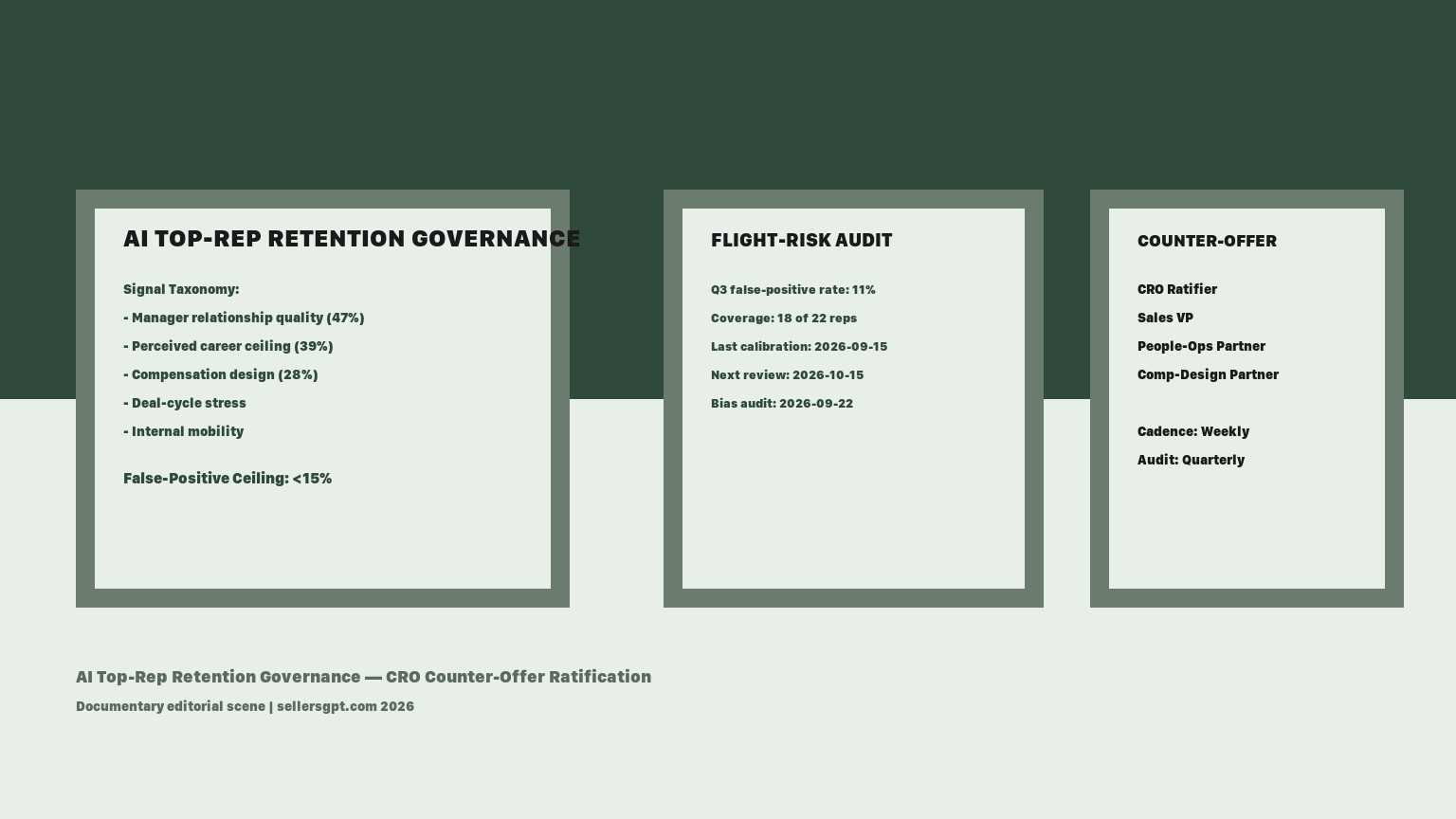
The answer to that question starts with the signal taxonomy. AI top-rep retention governance must begin with a written taxonomy of the behavioral signals the model is allowed to surface. The taxonomy must include both comp-driven signals (compensation design, accelerators, draw vs quota, mid-year re-baseline cadence) and non-comp signals (manager relationship quality, perceived career ceiling, deal-cycle stress, manager changes, peer-cohort attrition, internal-mobility patterns). Alexander Group's 2024 Sales Talent Retention Study finds that top-quartile B2B sales reps leave for non-comp reasons 71 percent of the time — manager relationship quality, career growth, and comp design in that order — and that AI-driven flight-risk models that ignore non-comp signals generate a 32 percent false-positive rate (Alexander Group Sales Talent Retention Study 2024, p. 14). HBR's September 2024 research reinforces the point: manager relationship quality is cited by 47 percent of departing top reps as their primary reason for leaving, perceived career ceiling by 39 percent, and compensation design by only 28 percent; AI tools that flag only comp-driven flight risk miss 72 percent of true cases (HBR, Why Top Sales Reps Quit — And What Smart Leaders Do About It, September 2024). A retention taxonomy that does not include the non-comp signals is a retention taxonomy that produces more false positives than true alerts.
The named ratification authority: the CRO owns the counter-offer
The signal taxonomy is the first control. The second control is the false-positive ceiling. A retention governance program must specify a maximum acceptable false-positive rate for the AI flight-risk model — typically below 15 percent for top-quartile rep alerts, lower than the ceiling for middle-quartile alerts — and the program must include a quarterly audit that measures the model's actual false-positive rate against the ceiling. Alexander Group's 2024 data finds that AI flight-risk models without an explicit false-positive ceiling average 32 percent false-positive rates, and that the false positives damage rep trust faster than the true positives save strategic accounts (Alexander Group Sales Talent Retention Study 2024, p. 14). The ceiling is a written number, not a soft target, and the quarterly audit is a named ritual with a written artifact.
The bias and disparate-impact audit
The third control is the named ratification authority. The CRO — not the AI model, not the sales-operations manager, not the people-operations partner alone — owns the counter-offer decision for a top-quartile rep flagged by the AI. The rationale is documented in the OECD AI Principles (2019, updated 2024), which require accountability for AI-assisted decisions that materially affect individuals, including employees; counter-offer decisions triggered by AI signals must include a named human ratifier and an auditable decision trail (OECD AI Principles 2019/2024, Section 1.5). The CRO is the named ratifier because the CRO is the person who can answer the strategic question — is this rep's strategic-account value worth a counter-offer that breaks the published compensation band? — without escalating to a board committee. The ratification meeting is a fixed-cadence ritual, typically weekly during a retention wave, with the CRO, the relevant sales VP, the people-operations partner, and the compensation-design partner as named attendees, and with a written decision artifact per rep under review.
The privacy boundary, written before the model goes into production
The fourth control is the bias and disparate-impact audit. NIST's AI Risk Management Framework 1.0, published in January 2023, requires bias and disparate-impact evaluation for AI systems affecting employment decisions, including retention and counter-offer triggers, with documented mitigation under the GOVERN function (NIST AI RMF 1.0, MEASURE 2.11 and GOVERN 4.1). The audit is a quarterly review of the AI flight-risk model's outputs, broken out by demographic category where legally permissible, with documented mitigation steps when the model produces disparate impact. The audit's artifact is a written memo signed by the people-operations partner and the legal partner, archived alongside the model's quarterly false-positive audit, and reviewed by the named ratification authority before the next retention cycle.
The five-stage cadence with a written artifact per stage
The fifth control is the privacy boundary. AI flight-risk models ingest signals that the rep did not consent to be aggregated at the time of hire — calendar density, internal mobility applications, peer-network graph centrality, compensation-band comparisons. The privacy boundary must be written before the model goes into production: what signals the AI may ingest, what signals the AI may not ingest, what retention period applies to the model's intermediate outputs, and what deletion protocol applies when the rep leaves the company. The boundary is a written document, not a soft target, and it is reviewed by the legal partner and the people-operations partner before the model reaches the ratification meeting.
Common failure modes: alerts without a ratifier, programs without practice
The five-stage cadence most often associated with high-performing AI top-rep retention governance looks like this. Stage one is the quarterly signal-taxonomy review, signed off by the CRO and the people-operations partner. Stage two is the quarterly false-positive audit, run against the model's actual outputs, signed off by the data-governance partner. Stage three is the weekly ratification meeting, with the CRO as the named ratifier and a written decision artifact per flagged rep. Stage four is the quarterly bias and disparate-impact audit, signed off by the people-operations partner and the legal partner. Stage five is the privacy-boundary review, run annually, signed off by the legal partner, with a written deletion protocol for any rep whose tenure has ended. Each stage produces a written artifact that the next stage cites; the artifacts together constitute the governance audit trail that the OECD AI Principles and the NIST AI RMF both require.
The opening moves for revenue leaders starting an AI retention program
The common failure mode is the AI flight-risk model that runs without a named ratifier. A vendor sells a beautiful dashboard; the sales-operations manager wires it into the retention conversation; the manager sees an alert and acts on it without escalation. The rep gets a counter-offer that arrived unprompted, the manager intervention reads as surveillance, and the rep's trust in the organization erodes. The false negative would have been costly; the false positive was costlier. AI top-rep retention governance is the program that prevents the false positive by routing every alert through a named ratification authority before any retention intervention is offered. Without that ratification authority, the AI model is making employment decisions that the OECD AI Principles and the NIST AI RMF both forbid.
Frequently asked questions
What if the AI model already produces flight-risk alerts without a signal taxonomy?
Pause the alerts until the taxonomy is written and signed off by the CRO and the people-operations partner. An alert without a documented taxonomy is a vendor decision; an alert with a documented taxonomy is a governance decision. The first audit reclassifies all existing alerts against the new taxonomy before any retention intervention is offered.
What if the false-positive ceiling is too tight?
Quarantine rises, the human review queue grows, the retention intervention rate falls, and the team is reluctant to act on alerts. The discipline is to set the ceiling above the noise floor of the model's calibration curve, then review the ceiling at the cadence the protocol names (typically quarterly). A too-tight ceiling is a recoverable configuration problem; an undocumented ceiling is an unrecoverable audit problem.
What if the CRO is not available for the ratification meeting?
A delegated ratifier is acceptable if the delegation is written, the CRO counter-signs the delegation, and the people-operations partner and the legal partner are present at the meeting. An undocumented delegation is an employment decision without a named authority; a written delegation is a governance decision with accountability.
What if the bias audit finds disparate impact?
Document the finding, pause the relevant slice of the model's output, retrain or re-calibrate the model against the documented mitigation plan, and re-audit before resuming the alerts. The OECD AI Principles and the NIST AI RMF both require documented mitigation; an undocumented fix is an open audit finding.
Does this apply to non-top-quartile reps?
The same controls apply with adjusted thresholds. The retention economics get sharper at the top quartile, but the discipline (signal taxonomy, false-positive ceiling, named ratification, bias audit, privacy boundary) applies at every quartile. The cadence may tighten or loosen; the controls must exist.
SOURCES & EDITORIAL NOTE
This article is an editorial framework, not an HR or legal advisory. The retention-cost benchmarks come from Salesforce State of Sales 8th Edition (2025) and Alexander Group Sales Talent Retention Study 2024; the manager-quality research from Harvard Business Review's September 2024 piece on why top reps quit; the bias-audit and human-decision framing from NIST AI RMF 1.0 (January 2023); and the accountability framing for AI-assisted employment decisions from OECD AI Principles (2019, updated 2024). All sources were fetched and verified on 2026-09-22. The retention-signal taxonomy, the false-positive ceiling, the named CRO ratification, the bias-and-disparate-impact audit, and the privacy boundary are SellersGPT editorial recommendations and starting points.
- Salesforce: State of Sales 8th Edition (2025)
- National Institute of Standards and Technology (NIST): NIST AI RMF 1.0 — MEASURE and GOVERN
- OECD.AI: AI Principles Overview
- Alexander Group: Sales Talent Retention Study 2024
- Harvard Business Review: Why Top Sales Reps Quit — And What Smart Leaders Do About It
MORE PRACTICAL IDEAS FOR B2B GROWTH
Related Articles

BUILD A PIPELINE THAT YOUR TEAM CAN SEE
Find more B2B buyers-without building a bigger team first. Tell us what you sell, which markets you want to reach, and what should count as a Qualified Lead. We'll help you build a repeatable path to the right buyers.